
Ch. 15 Sensory Pathways and the Somatic Nervous System
Martini - Fundamentals of Anatomy & Physiology 11th Edition
Martini, Nath, Bartholomew11th EditionFundamentals of Anatomy & PhysiologyISBN: 9780136874089Non è quello che usi tu?Cambia libro di testo
Capitolo 15, Problema 16

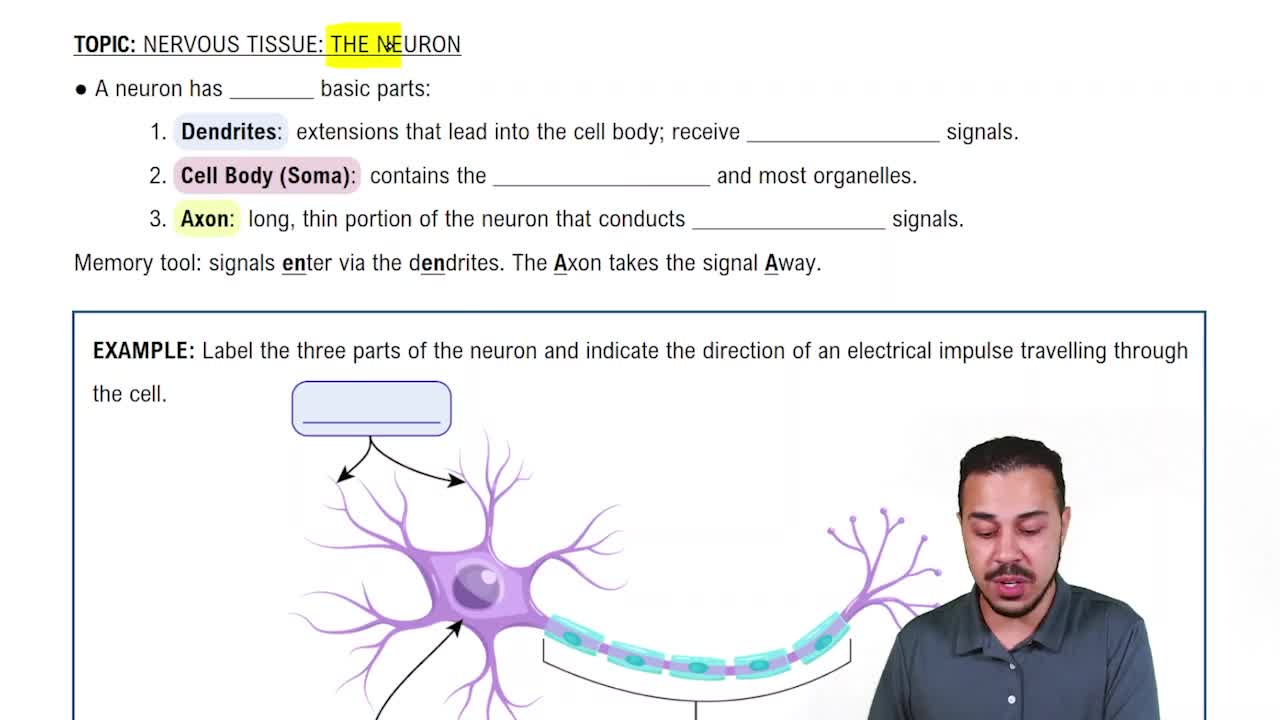
Describe the relationship among first-order, second-order, and third-order neurons in a sensory pathway.

Guida verificata passo dopo passo
1
Step 1: Understand that sensory pathways transmit information from sensory receptors to the brain through a series of neurons, typically organized into first-order, second-order, and third-order neurons.
Step 2: Identify the role of the first-order neuron, which is the sensory neuron that detects the stimulus and carries the signal from the peripheral receptor to the spinal cord or brainstem.
Step 3: Recognize that the second-order neuron receives the signal from the first-order neuron within the central nervous system (spinal cord or brainstem) and transmits it to the thalamus or another relay center in the brain.
Step 4: Note that the third-order neuron carries the sensory information from the thalamus to the specific region of the cerebral cortex responsible for processing that type of sensory input.
Step 5: Summarize the relationship as a sequential relay system where each neuron type passes the sensory signal along the pathway, progressively transmitting and processing the information until it reaches conscious perception in the brain.

Risposta video verificata per un problema simile:

Questa soluzione video è stata consigliata dai nostri tutor come utile per risolvere questo problema.

Concetti chiave

Ecco i concetti essenziali che devi comprendere per rispondere correttamente alla domanda.

First-Order Neurons

First-order neurons are the primary sensory neurons that detect stimuli from the environment or body and transmit this information from peripheral receptors to the spinal cord or brainstem. They serve as the initial link in the sensory pathway, converting physical stimuli into neural signals.
Video consigliato:
04:20
The Neuron

Second-Order Neurons

Second-order neurons receive signals from first-order neurons and relay this information to higher brain centers, typically the thalamus. They often cross to the opposite side of the central nervous system, enabling the brain to process sensory input from the contralateral side of the body.
Video consigliato:
04:20
The Neuron

Third-Order Neurons

Third-order neurons transmit sensory information from the thalamus to the cerebral cortex, where conscious perception occurs. They complete the sensory pathway by allowing the brain to interpret and respond to sensory stimuli, such as touch, pain, or temperature.
Video consigliato:
04:20
The Neuron