
Ch. 15 Sensory Pathways and the Somatic Nervous System
Martini - Fundamentals of Anatomy & Physiology 11th Edition
Martini, Nath, Bartholomew11th EditionFundamentals of Anatomy & PhysiologyISBN: 9780136874089Non è quello che usi tu?Cambia libro di testo
Capitolo 15, Problema 13

What three steps are necessary for transduction to occur?

Guida verificata passo dopo passo
1
Understand that transduction in physiology refers to the process by which a sensory receptor converts a specific type of stimulus into an electrical signal (nerve impulse).
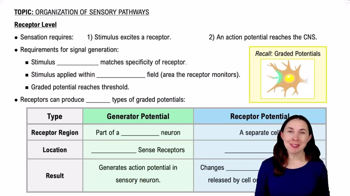
Identify the first step: the sensory receptor must detect the stimulus (such as light, sound, pressure, or chemical signals) and respond to it by opening or closing ion channels, leading to a change in the receptor's membrane potential. This is called the receptor potential.
Recognize the second step: the receptor potential must reach a threshold to generate an action potential. This involves the conversion of the graded receptor potential into a nerve impulse if the stimulus is strong enough.
Note the third step: the action potential is then propagated along the sensory neuron to the central nervous system, where it can be processed and interpreted as a sensation.
Summarize that these three steps—stimulus detection and receptor potential generation, conversion to an action potential, and propagation of the nerve impulse—are essential for sensory transduction to occur.

Risposta video verificata per un problema simile:

Questa soluzione video è stata consigliata dai nostri tutor come utile per risolvere questo problema.

Concetti chiave

Ecco i concetti essenziali che devi comprendere per rispondere correttamente alla domanda.

Signal Reception

Signal reception is the initial step where a cell detects an external signal, such as a chemical messenger or environmental cue, through specific receptors on its surface or inside the cell. This recognition is crucial for initiating the transduction process.
Video consigliato:
4:47
Receptor Level

Signal Transduction Pathway

This step involves the conversion of the received signal into a form that can elicit a cellular response. It typically includes a series of molecular events like phosphorylation cascades or second messenger activation that amplify and relay the signal inside the cell.
Video consigliato:
Percorso guidato
4:40
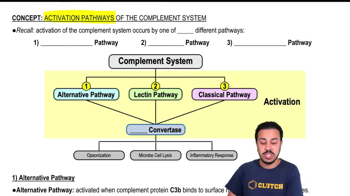
Alternative Pathway

Cellular Response

The final step is the cellular response, where the transduced signal triggers specific changes in cell behavior or function, such as gene expression, enzyme activity, or ion channel opening, enabling the cell to adapt or react appropriately to the initial signal.
Video consigliato:
Percorso guidato
9:59
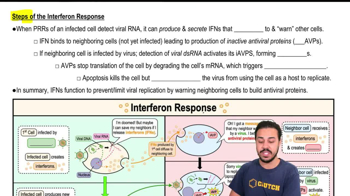
Steps of the Interferon Response