Ch. 15 Sensory Pathways and the Somatic Nervous System
Martini - Fundamentals of Anatomy & Physiology 11th Edition
Martini, Nath, Bartholomew11th EditionFundamentals of Anatomy & PhysiologyISBN: 9780136874089Non è quello che usi tu?Cambia libro di testo
Capitolo 15, Problema 10

Which three motor tracts make up the medial pathway?

Guida verificata passo dopo passo
1
Step 1: Understand that the medial pathway is a group of motor tracts in the central nervous system responsible for controlling gross movements of the trunk and proximal limb muscles, especially those involved in posture and balance.
Step 2: Recall that the medial pathway includes tracts that originate primarily in the brainstem and descend in the spinal cord to influence motor neurons controlling axial and proximal muscles.
Step 3: Identify the three main motor tracts that compose the medial pathway: the vestibulospinal tract, the reticulospinal tract, and the tectospinal tract.
Step 4: Recognize the function of each tract: the vestibulospinal tract helps maintain balance and posture by influencing extensor muscles; the reticulospinal tract modulates voluntary movements and reflexes; and the tectospinal tract coordinates head and eye movements in response to visual stimuli.
Step 5: Summarize that these three tracts together form the medial pathway, which is essential for maintaining posture and coordinating gross motor movements.

Risposta video verificata per un problema simile:

Questa soluzione video è stata consigliata dai nostri tutor come utile per risolvere questo problema.

Concetti chiave

Ecco i concetti essenziali che devi comprendere per rispondere correttamente alla domanda.

Medial Motor Pathways

The medial motor pathways are a group of descending tracts in the spinal cord that primarily control posture and gross movements of the trunk and proximal limbs. They originate mainly from the brainstem and are involved in maintaining balance and coordinating large muscle groups.
Video consigliato:
Percorso guidato
4:40
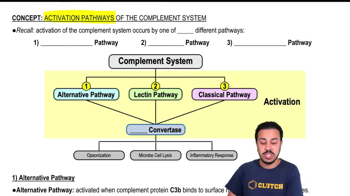
Alternative Pathway

Reticulospinal Tract

The reticulospinal tract arises from the reticular formation in the brainstem and influences voluntary movements and muscle tone. It plays a key role in posture control and locomotion by modulating spinal reflexes and coordinating muscle activity.
Video consigliato:
Percorso guidato
0:49
Secondary Lymphoid Organs: MALT Example 1

Vestibulospinal and Tectospinal Tracts

The vestibulospinal tract originates from the vestibular nuclei and helps maintain balance by controlling extensor muscles. The tectospinal tract arises from the superior colliculus and mediates reflexive head and eye movements in response to visual stimuli. Both are components of the medial pathway.
Video consigliato:
Percorso guidato
0:49
Secondary Lymphoid Organs: MALT Example 1