
Ch. 16 The Autonomic Nervous System and Higher-Order Functions
Martini - Fundamentals of Anatomy & Physiology 11th Edition
Martini, Nath, Bartholomew11th EditionFundamentals of Anatomy & PhysiologyISBN: 9780136874089Non è quello che usi tu?Cambia libro di testo
Capitolo 16, Problema 24

Under which of the following circumstances would the diameter of peripheral blood vessels be greatest?
(a) Increased sympathetic stimulation
(b) Decreased sympathetic stimulation
(c) Increased parasympathetic stimulation
(d) Decreased parasympathetic stimulation
(e) Both increased parasympathetic and sympathetic stimulation

Guida verificata passo dopo passo
1
Understand that the diameter of peripheral blood vessels is primarily controlled by the autonomic nervous system, specifically through sympathetic stimulation, which generally causes vasoconstriction (narrowing of blood vessels).
Recognize that increased sympathetic stimulation typically causes vasoconstriction, reducing the diameter of peripheral blood vessels, while decreased sympathetic stimulation leads to vasodilation (widening of blood vessels), increasing their diameter.
Note that parasympathetic stimulation has minimal direct effect on most peripheral blood vessels, so changes in parasympathetic activity usually do not significantly alter vessel diameter.
Evaluate each option by considering whether it would increase or decrease sympathetic or parasympathetic activity and how that would affect vessel diameter:
Conclude that the greatest diameter of peripheral blood vessels would occur under conditions of decreased sympathetic stimulation, as this reduces vasoconstriction and allows vessels to dilate.

Risposta video verificata per un problema simile:

Questa soluzione video è stata consigliata dai nostri tutor come utile per risolvere questo problema.

Concetti chiave

Ecco i concetti essenziali che devi comprendere per rispondere correttamente alla domanda.

Sympathetic Nervous System and Vascular Tone

The sympathetic nervous system primarily controls the constriction of peripheral blood vessels through the release of norepinephrine, which binds to alpha-adrenergic receptors causing vasoconstriction. Increased sympathetic stimulation typically reduces vessel diameter, while decreased stimulation leads to vasodilation.
Video consigliato:
1:21
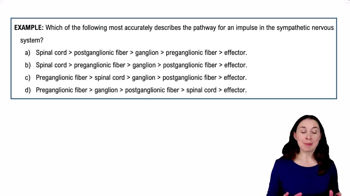
Sympathetic Nervous System Example 3

Parasympathetic Nervous System Influence on Blood Vessels

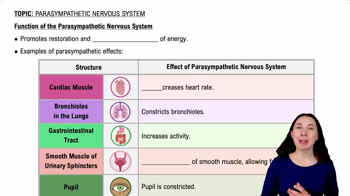
The parasympathetic nervous system generally has minimal direct effect on peripheral blood vessel diameter, as most vessels lack significant parasympathetic innervation. Its role is more prominent in regulating heart rate and glandular secretions rather than vascular tone.
Video consigliato:
1:56
Function of the Parasympathetic Nervous System

Vasodilation and Vasoconstriction Mechanisms

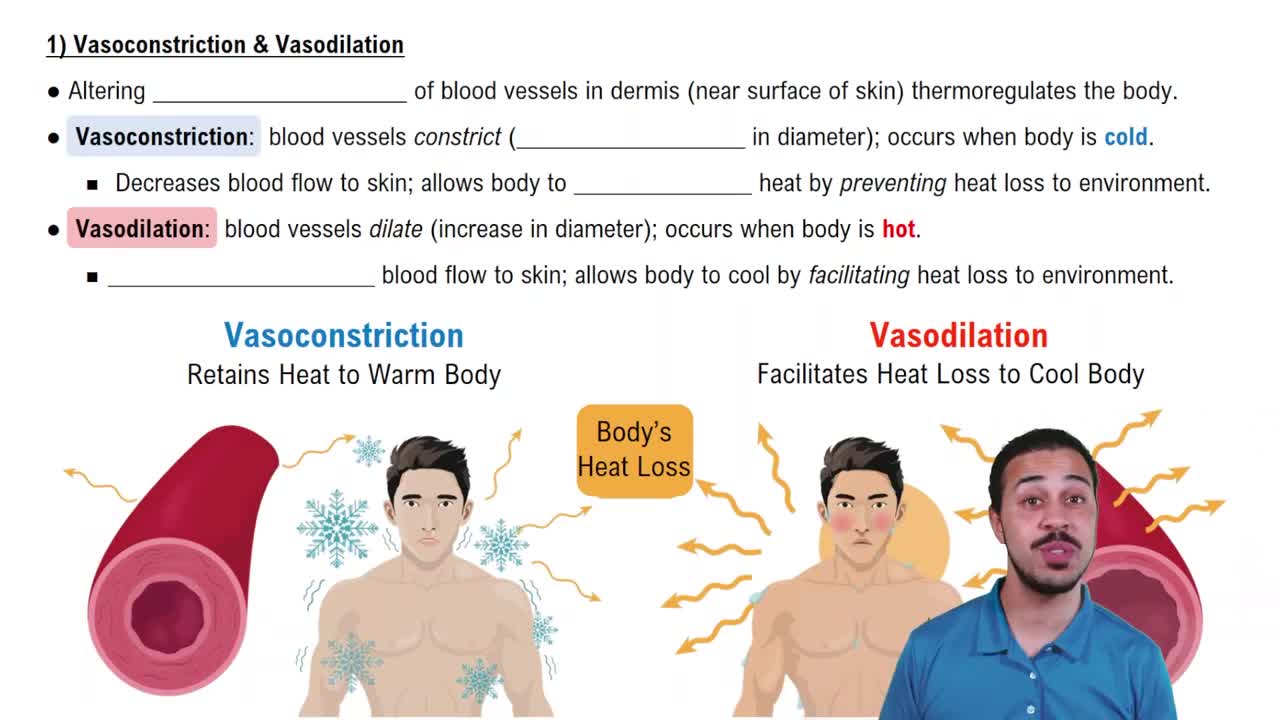
Vasodilation is the widening of blood vessels, often caused by decreased sympathetic activity or local chemical signals, increasing blood flow. Vasoconstriction is the narrowing of vessels, usually triggered by increased sympathetic stimulation, reducing blood flow. Understanding these mechanisms helps explain changes in vessel diameter.
Video consigliato:
Percorso guidato
05:07
Vasoconstriction & Vasodilation