
Ch. 16 The Autonomic Nervous System and Higher-Order Functions
Martini - Fundamentals of Anatomy & Physiology 11th Edition
Martini, Nath, Bartholomew11th EditionFundamentals of Anatomy & PhysiologyISBN: 9780136874089Non è quello che usi tu?Cambia libro di testo
Capitolo 16, Problema 26

You are home alone at night when you hear what sounds like breaking glass. What physiological effects would this experience probably produce, and what would be their cause?

Guida verificata passo dopo passo
1
Step 1: Identify the type of stimulus and the body's initial response. Hearing breaking glass at night is perceived as a sudden, potentially threatening stimulus, which activates the body's stress response system.
Step 2: Understand the role of the sympathetic nervous system. This system is part of the autonomic nervous system and is responsible for the 'fight or flight' response, preparing the body to react to danger.
Step 3: Describe the physiological effects triggered by sympathetic activation. These include increased heart rate, dilation of the pupils, increased respiratory rate, and release of adrenaline (epinephrine) from the adrenal medulla.
Step 4: Explain the cause of these effects. The hypothalamus detects the threat and signals the adrenal medulla to release adrenaline, which then acts on various organs to produce the physiological changes that prepare the body for rapid action.
Step 5: Summarize the overall effect. The combination of nervous system activation and hormone release results in heightened alertness, increased energy availability, and enhanced physical readiness to respond to the perceived threat.

Risposta video verificata per un problema simile:

Questa soluzione video è stata consigliata dai nostri tutor come utile per risolvere questo problema.

Concetti chiave

Ecco i concetti essenziali che devi comprendere per rispondere correttamente alla domanda.

Fight-or-Flight Response

The fight-or-flight response is the body's automatic reaction to perceived danger, triggering physiological changes like increased heart rate and adrenaline release. It prepares the body to either confront or escape a threat, enhancing alertness and physical readiness.
Video consigliato:
Percorso guidato
9:59
Steps of the Interferon Response

Sympathetic Nervous System Activation

The sympathetic nervous system activates during stressful or threatening situations, stimulating the adrenal glands to release adrenaline and noradrenaline. This activation causes increased heart rate, dilated pupils, and redirected blood flow to muscles, enabling quick physical responses.
Video consigliato:
1:20
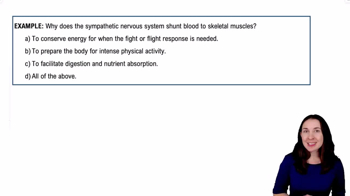
Sympathetic Nervous System Example 1

Stress Hormones and Their Effects

Stress hormones such as adrenaline and cortisol are released during acute stress, affecting various body systems. They increase energy availability, suppress non-essential functions like digestion, and heighten sensory perception, all aimed at improving survival chances in emergencies.
Video consigliato:
Percorso guidato
1:32
Effects of the Complement System
Pratica correlata
Domanda del libro di testo

Under which of the following circumstances would the diameter of peripheral blood vessels be greatest?

(a) Increased sympathetic stimulation

(b) Decreased sympathetic stimulation

(c) Increased parasympathetic stimulation

(d) Decreased parasympathetic stimulation

(e) Both increased parasympathetic and sympathetic stimulation

697
views
Domanda del libro di testo

A possible side effect of a drug used to open the airways of someone suffering from an asthma attack is

(a) Decreased activity of the digestive system

(b) Diarrhea

(c) Profuse urination

(d) Increased blood pressure

(e) Decreased heart rate

822
views
Domanda del libro di testo

The condition known as shock is characterized in part by a decreased return of venous blood to the heart. How could an upsetting situation, such as the sight of a tragic accident or very bad news, produce some temporary symptoms of shock?

744
views
Domanda del libro di testo

Nicotine stimulates cholinergic receptors of the ANS. Based on this information, how would cigarette smoking affect the cardiovascular system?

700
views
Domanda del libro di testo

During sympathetic stimulation, a person may begin to feel 'on edge'; this is the result of

(a) Increased energy metabolism by muscle tissue

(b) Increased cardiovascular activity

(c) Stimulation of the reticular activating system

(d) Temporary insensitivity to painful stimuli

(e) Decreased levels of epinephrine in the blood

753
views
Domanda del libro di testo

Why is autonomic tone a significant part of ANS function?

1470
views