
Ch. 16 The Autonomic Nervous System and Higher-Order Functions
Martini - Fundamentals of Anatomy & Physiology 11th Edition
Martini, Nath, Bartholomew11th EditionFundamentals of Anatomy & PhysiologyISBN: 9780136874089Non è quello che usi tu?Cambia libro di testo
Capitolo 16, Problema 31

While studying the activity of smooth muscle in blood vessels, Shelly discovers that, when applied to a muscle plasma membrane, a molecule chemically similar to a neurotransmitter triggers an increase in intracellular calcium ions. Which neurotransmitter is the molecule mimicking, and to which receptors is it binding?

Guida verificata passo dopo passo
1
Step 1: Identify the neurotransmitter involved in smooth muscle contraction in blood vessels. In vascular smooth muscle, the primary neurotransmitter that increases intracellular calcium ions is acetylcholine (ACh) or norepinephrine, but acetylcholine is well-known for acting through receptors that increase intracellular calcium.
Step 2: Understand the receptor types on smooth muscle plasma membranes that respond to neurotransmitters. Acetylcholine binds to muscarinic receptors (a type of G protein-coupled receptor) on smooth muscle cells, which leads to an increase in intracellular calcium.
Step 3: Recall the signaling pathway triggered by muscarinic receptor activation. When acetylcholine binds to muscarinic receptors, it activates phospholipase C via G proteins, which then produces inositol triphosphate (IP3). IP3 causes calcium release from the sarcoplasmic reticulum, increasing intracellular calcium concentration.
Step 4: Conclude that the molecule mimicking the neurotransmitter is acting like acetylcholine, binding specifically to muscarinic receptors on the smooth muscle plasma membrane.
Step 5: Summarize that the increase in intracellular calcium ions is due to activation of muscarinic receptors by an acetylcholine-like molecule, which triggers calcium release and smooth muscle contraction.

Risposta video verificata per un problema simile:

Questa soluzione video è stata consigliata dai nostri tutor come utile per risolvere questo problema.

Concetti chiave

Ecco i concetti essenziali che devi comprendere per rispondere correttamente alla domanda.

Neurotransmitters in Smooth Muscle Regulation

Neurotransmitters are chemical messengers that influence smooth muscle activity by binding to specific receptors. In blood vessels, acetylcholine is a key neurotransmitter that can cause smooth muscle contraction or relaxation by altering intracellular calcium levels.
Video consigliato:
06:27
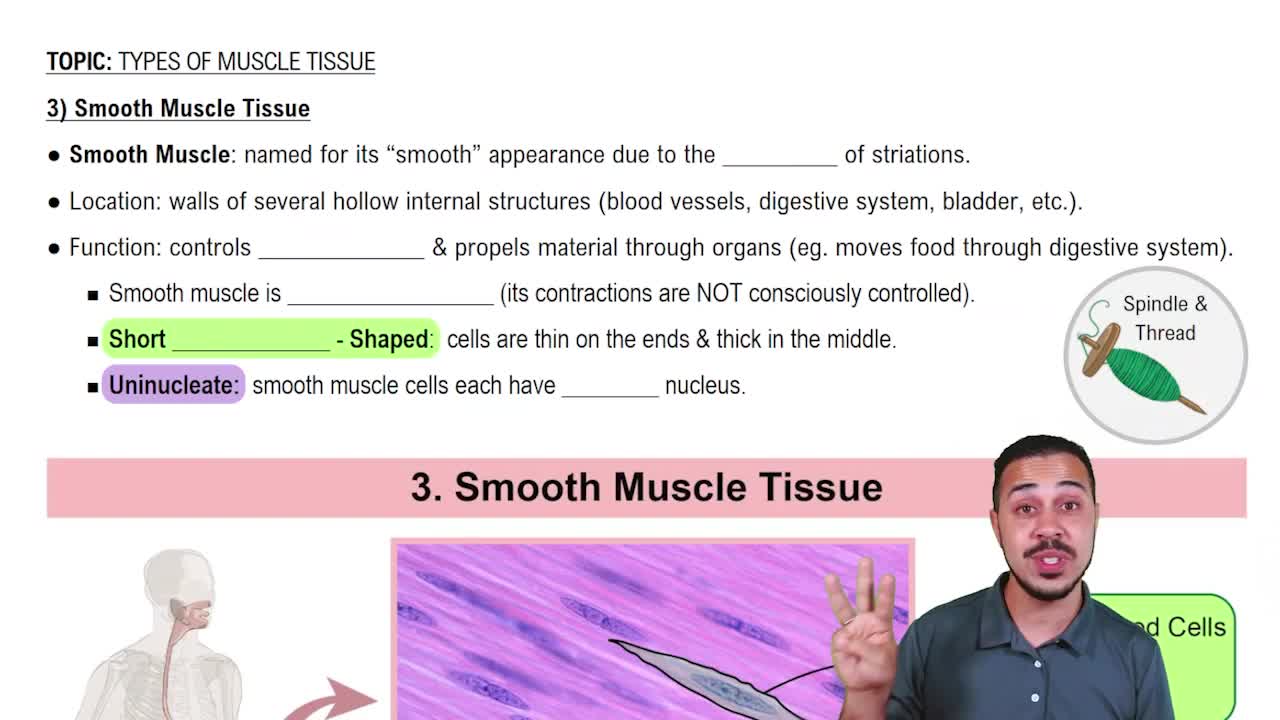
Smooth Muscle Tissue

Receptors Mediating Calcium Influx in Smooth Muscle

Muscle plasma membranes have receptors such as muscarinic acetylcholine receptors (M3 subtype) that, when activated, trigger intracellular signaling pathways leading to calcium release from internal stores or calcium influx, increasing intracellular calcium concentration and causing muscle contraction.
Video consigliato:
06:27
Smooth Muscle Tissue

Role of Intracellular Calcium in Smooth Muscle Contraction

Intracellular calcium ions act as a crucial second messenger in smooth muscle cells, initiating contraction by activating the contractile machinery. An increase in calcium concentration typically results from receptor activation and is essential for muscle tone regulation in blood vessels.
Video consigliato:
4:53
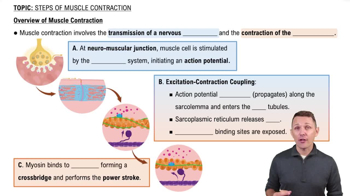
Overview of Muscle Contraction