
Ch. 3 The Cellular Level of Organization
Martini - Fundamentals of Anatomy & Physiology 11th Edition
Martini, Nath, Bartholomew11th EditionFundamentals of Anatomy & PhysiologyISBN: 9780136874089Non è quello che usi tu?Cambia libro di testo
Capitolo 3, Problema 19

When a cell is placed in a(n)___solution, the cell will lose water through osmosis. This process results in the___ of red blood cells
(a) hypotonic; crenation
(b) hypertonic; crenation
(c) isotonic; hemolysis
(d) hypotonic; hemolysis

Guida verificata passo dopo passo
1
Step 1: Understand the concept of tonicity and osmosis. Tonicity refers to the relative concentration of solutes outside the cell compared to inside the cell, which affects water movement by osmosis.
Step 2: Identify what happens when a cell is placed in a hypertonic solution. A hypertonic solution has a higher solute concentration outside the cell than inside, causing water to move out of the cell.
Step 3: Recognize the effect of water loss on red blood cells. When water leaves the cell, the cell shrinks and develops a spiky or scalloped appearance, a process called crenation.
Step 4: Match the correct terms to the scenario. Since the cell loses water, the solution must be hypertonic, and the resulting effect on red blood cells is crenation.
Step 5: Conclude that the correct answer is the option describing a hypertonic solution causing crenation of red blood cells.

Risposta video verificata per un problema simile:

Questa soluzione video è stata consigliata dai nostri tutor come utile per risolvere questo problema.
Durata del video:
2m

Concetti chiave

Ecco i concetti essenziali che devi comprendere per rispondere correttamente alla domanda.

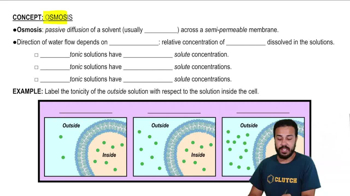
Osmosis

Osmosis is the movement of water molecules across a semipermeable membrane from an area of lower solute concentration to higher solute concentration. This process aims to equalize solute concentrations on both sides of the membrane, affecting cell volume and shape.
Video consigliato:

Tonicity of Solutions

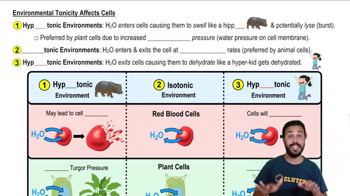
Tonicity describes the relative concentration of solutes outside a cell compared to inside. A hypertonic solution has higher solute concentration outside, causing water to leave the cell; hypotonic is lower outside, causing water to enter; isotonic means equal concentrations, so no net water movement occurs.
Video consigliato:
Percorso guidato
10:15
Environmental Tonicity Affects Cells

Effects on Red Blood Cells: Crenation and Hemolysis

Crenation occurs when red blood cells lose water in a hypertonic solution, causing them to shrink and develop a scalloped surface. Hemolysis happens in a hypotonic solution when water enters the cells, causing them to swell and potentially burst.
Video consigliato:
Percorso guidato
2:58
Comic Strip for Effects of T Cell Functions
Pratica correlata