
Ch. 3 The Cellular Level of Organization
Martini - Fundamentals of Anatomy & Physiology 11th Edition
Martini, Nath, Bartholomew11th EditionFundamentals of Anatomy & PhysiologyISBN: 9780136874089Non è quello che usi tu?Cambia libro di testo
Capitolo 3, Problema 20

Suppose that a DNA segment has the following nucleotide sequence:
CTC–ATA–CGA–TTC–AAG–TTA.
Which nucleotide sequences would a complementary mRNA strand have?
(a) GAG–UAU–GAU–AAC–UUG–AAU
(b) GAG–TAT–GCT–AAG–TTC–AAT
(c) GAG–UAU–GCU–AAG–UUC–AAU
(d) GUG–UAU–GGA–UUG–AAC–GGU

Guida verificata passo dopo passo
1
Identify the direction of the given DNA sequence and remember that mRNA is synthesized complementary to the DNA template strand, replacing thymine (T) with uracil (U).
Recall the base pairing rules for transcription: DNA adenine (A) pairs with RNA uracil (U), DNA thymine (T) pairs with RNA adenine (A), DNA cytosine (C) pairs with RNA guanine (G), and DNA guanine (G) pairs with RNA cytosine (C).
Write down the complementary RNA sequence for each DNA triplet by applying the base pairing rules, converting each DNA nucleotide to its RNA complement.
Group the resulting RNA nucleotides into codons (triplets) to match the format of the options given.
Compare your transcribed mRNA sequence with the provided options to determine which one correctly represents the complementary mRNA strand.

Risposta video verificata per un problema simile:

Questa soluzione video è stata consigliata dai nostri tutor come utile per risolvere questo problema.
Durata del video:
2m

Concetti chiave

Ecco i concetti essenziali che devi comprendere per rispondere correttamente alla domanda.

DNA and RNA Base Pairing Rules

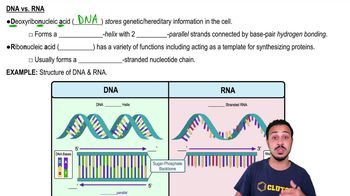
DNA and RNA strands pair through complementary bases: in DNA, adenine (A) pairs with thymine (T), and cytosine (C) pairs with guanine (G). In RNA, uracil (U) replaces thymine, so adenine pairs with uracil. Understanding these rules is essential to transcribe a DNA sequence into its complementary mRNA sequence.
Video consigliato:

Transcription Process

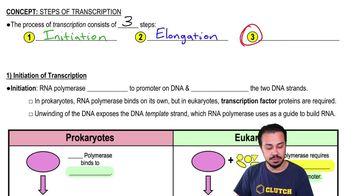
Transcription is the process where an mRNA strand is synthesized from a DNA template strand. The mRNA sequence is complementary to the DNA template strand and uses uracil instead of thymine. This process is key to converting the given DNA sequence into the correct mRNA sequence.
Video consigliato:
Percorso guidato
04:16
1) Initiation of Transcription

Directionality of Nucleic Acid Strands

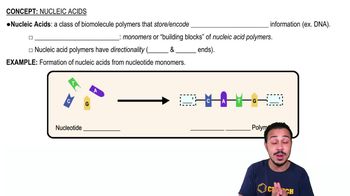
Nucleic acid sequences have directionality, typically written 5' to 3'. During transcription, the mRNA is synthesized antiparallel to the DNA template strand, meaning the 3' to 5' DNA strand is read to produce a 5' to 3' mRNA strand. Recognizing this helps correctly align and transcribe the sequences.
Video consigliato: