Ch. 1 - Equations and Inequalities
Blitzer - College Algebra 8th Edition
Blitzer8th EditionCollege AlgebraISBN: 9780136970514Non è quello che usi tu?Cambia libro di testo
Capitolo 2, Problema 53

In Exercises 51–58, solve each compound inequality. - 3 ≤ x - 2 < 1

Guida verificata passo dopo passo
1
Start by understanding that the compound inequality \(-3 \leq x - 2 < 1\) means that \(x - 2\) is simultaneously greater than or equal to \(-3\) and less than \(1\).
To isolate \(x\), add \(2\) to all three parts of the inequality to maintain the balance. This gives: \(-3 + 2 \leq x - 2 + 2 < 1 + 2\).
Simplify each part: \(-1 \leq x < 3\).
Interpret the solution as all values of \(x\) that are greater than or equal to \(-1\) and less than \(3\).
Express the solution in interval notation as \([-1, 3)\), where the square bracket means inclusive of \(-1\) and the parenthesis means exclusive of \(3\).

Risposta video verificata per un problema simile:

Questa soluzione video è stata consigliata dai nostri tutor come utile per risolvere questo problema.
Durata del video:
1m

Concetti chiave

Ecco i concetti essenziali che devi comprendere per rispondere correttamente alla domanda.

Compound Inequalities

A compound inequality involves two inequalities joined together, often by 'and' or 'or'. In this problem, the compound inequality 3 ≤ x - 2 < 1 means x - 2 is simultaneously greater than or equal to 3 and less than 1. Understanding how to interpret and solve such inequalities is essential.
Video consigliato:
06:07
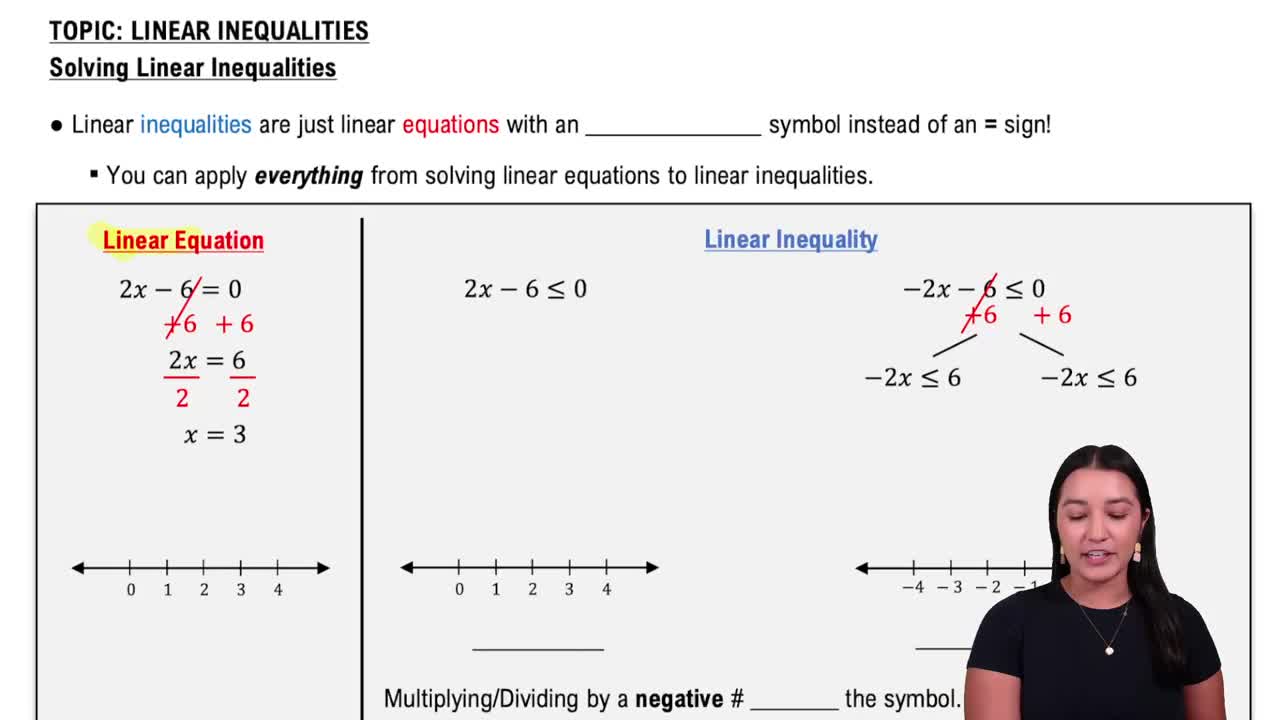
Linear Inequalities

Solving Linear Inequalities

Solving linear inequalities involves isolating the variable on one side by performing inverse operations, similar to solving equations. When dealing with inequalities, special attention is needed when multiplying or dividing by negative numbers, as this reverses the inequality sign.
Video consigliato:
06:07
Linear Inequalities

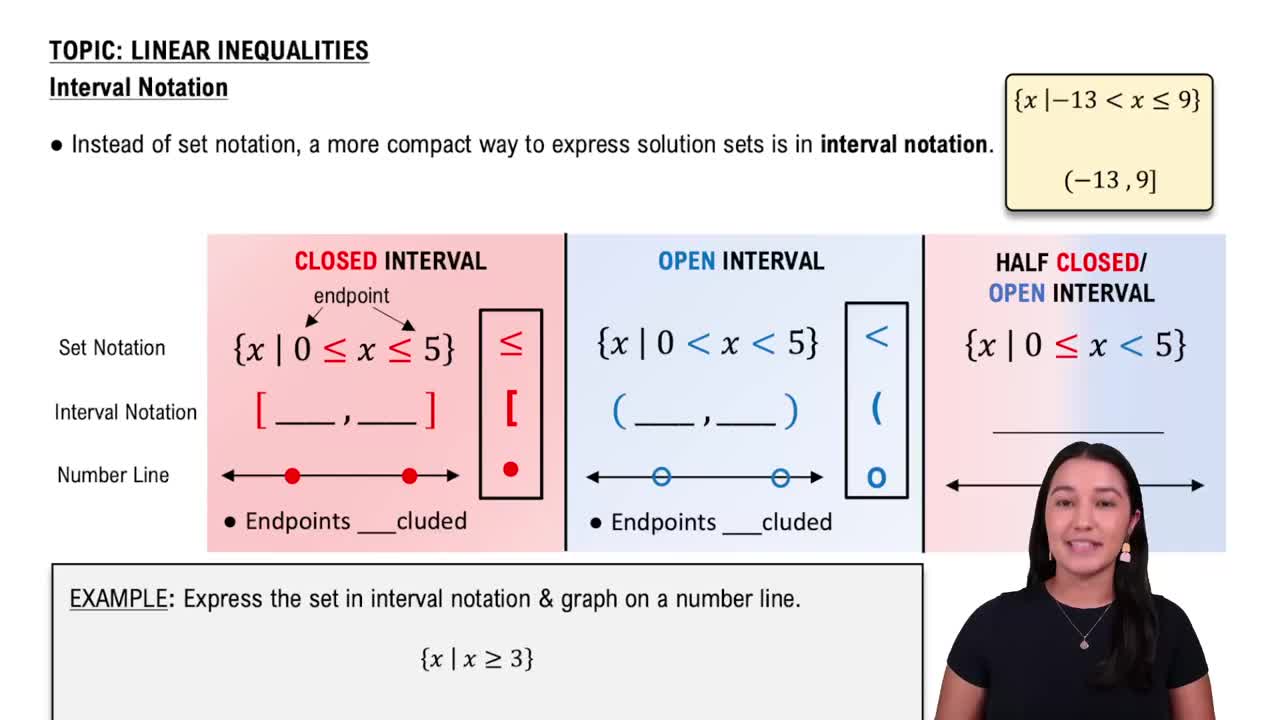
Interval Notation and Solution Sets

After solving inequalities, the solution is often expressed as an interval or set of values that satisfy the inequality. Understanding how to write and interpret these intervals helps communicate the solution clearly, especially for compound inequalities that define a range of values.
Video consigliato:
05:18
Interval Notation