Graph each linear function. 6x-5f(x) - 20 = 0
Ch. 2 - Functions and Graphs

Capitolo 3, Problema 82
In Exercises 82–84, find f + g, f - g, fg, and f/g. Determine the domain for each function. f(x) = 3x - 1, g(x) = x - 5
Guida verificata passo dopo passo1
Step 1: To find f + g, add the two functions f(x) and g(x). This means combining their expressions: f(x) + g(x) = (3x - 1) + (x - 5). Simplify the resulting expression by combining like terms.
Step 2: To find f - g, subtract g(x) from f(x). This means: f(x) - g(x) = (3x - 1) - (x - 5). Distribute the negative sign and simplify the resulting expression by combining like terms.
Step 3: To find fg, multiply the two functions f(x) and g(x). This means: fg(x) = (3x - 1)(x - 5). Use the distributive property (FOIL method) to expand the product and simplify the resulting expression.
Step 4: To find f/g, divide f(x) by g(x). This means: f/g(x) = (3x - 1) / (x - 5). Simplify the expression if possible. Note that the domain of this function excludes any value of x that makes the denominator zero, so x ≠ 5.
Step 5: Determine the domain for each function. For f + g, f - g, and fg, the domain is all real numbers because there are no restrictions (no division by zero or square roots of negative numbers). For f/g, the domain excludes x = 5 because division by zero is undefined.

Risposta video verificata per un problema simile:
Questa soluzione video è stata consigliata dai nostri tutor come utile per risolvere questo problema.
Durata del video:
3mConcetti chiave
Ecco i concetti essenziali che devi comprendere per rispondere correttamente alla domanda.
Function Operations
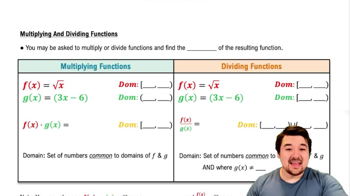
Function operations involve combining two functions through addition, subtraction, multiplication, or division. For example, if f(x) and g(x) are two functions, then f + g is defined as (f + g)(x) = f(x) + g(x). Understanding how to perform these operations is essential for solving problems that require the manipulation of multiple functions.
Video consigliato:
Multiplying & Dividing Functions
Domain of a Function
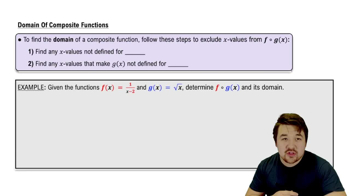
The domain of a function is the set of all possible input values (x-values) for which the function is defined. When performing operations on functions, it is crucial to determine the domain of the resulting function, as it may differ from the domains of the individual functions. For instance, in division, the denominator cannot be zero, which can restrict the domain.
Video consigliato:
Domain Restrictions of Composed Functions
Linear Functions
Linear functions are polynomial functions of degree one, represented in the form f(x) = mx + b, where m is the slope and b is the y-intercept. In the given problem, both f(x) = 3x - 1 and g(x) = x - 5 are linear functions. Understanding their properties, such as slope and intercepts, is important for analyzing their behavior and performing operations on them.
Video consigliato:
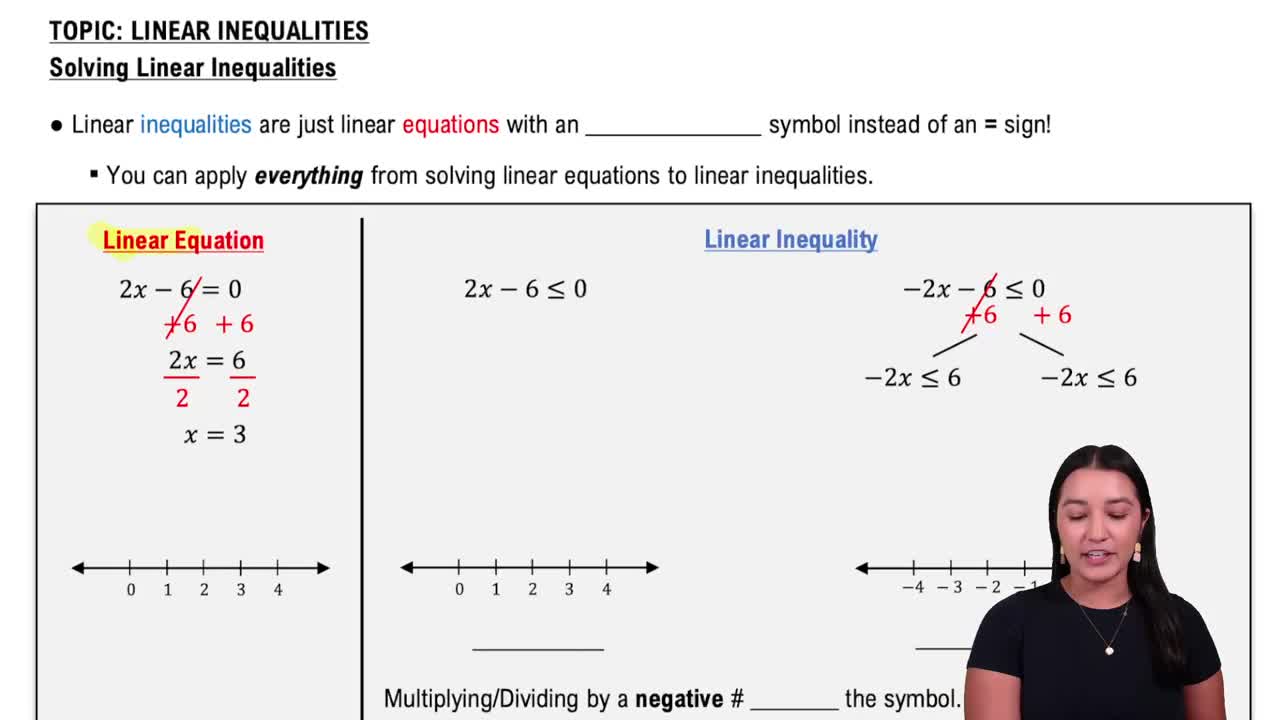
Linear Inequalities
Pratica correlata
Domanda del libro di testo
80
views
Domanda del libro di testo
Find f + g, f - g, fg, and f/g. f(x) = x2 + x + 1, g(x) = x2 -1
832
views
Domanda del libro di testo
Express the given function h as a composition of two functions ƒ and g so that h(x) = (fog) (x).
h(x) = 1/(2x-3)
1192
views
1
rank
Domanda del libro di testo
Begin by graphing the absolute value function, f(x) = |x|. Then use transformations of this graph to graph the given function. g(x) = |x|+3
819
views
Domanda del libro di testo
In Exercises 77–92, use the graph to determine a. the function's range; b. the y-intercept, if any; and e. the missing function values, indicated by question marks, below each graph.
106
views
Domanda del libro di testo
In Exercises 77–92, use the graph to determine a. the function's domain; b. the function's range; c. the x-intercepts, if any; d. the y-intercept, if any; and e. the missing function values, indicated by question marks, below each graph.
75
views