
Ch. 6 - Chromosome Mutations: Variation in Number and Arrangement
Klug - Essentials of Genetics 10th Edition
Klug10th EditionEssentials of GeneticsISBN: 9780135588789Non è quello che usi tu?Cambia libro di testo
Capitolo 6, Problema 1c

How do we know that specific mutant phenotypes are due to changes in chromosome number or structure?

Guida verificata passo dopo passo
1
Understand that mutant phenotypes caused by changes in chromosome number or structure are often identified through cytogenetic analysis, which involves examining the chromosomes under a microscope to detect abnormalities such as deletions, duplications, inversions, translocations, or aneuploidy.
Use karyotyping techniques to visualize the complete set of chromosomes from an individual and compare the chromosome number and structure to a normal reference to identify any deviations that correlate with the mutant phenotype.
Perform genetic mapping and linkage analysis to determine if the mutant phenotype co-segregates with known chromosomal rearrangements or aneuploid conditions, which helps establish a connection between the phenotype and chromosomal changes.
Apply molecular techniques such as fluorescence in situ hybridization (FISH) or comparative genomic hybridization (CGH) to detect specific structural changes or copy number variations in chromosomes that may underlie the mutant phenotype.
Correlate the observed chromosomal abnormalities with the mutant phenotype by studying multiple individuals or cell lines, ensuring that the phenotype consistently associates with the chromosomal change, thereby confirming causality.

Risposta video verificata per un problema simile:

Questa soluzione video è stata consigliata dai nostri tutor come utile per risolvere questo problema.
Durata del video:
1m

Concetti chiave

Ecco i concetti essenziali che devi comprendere per rispondere correttamente alla domanda.

Chromosomal Aberrations

Chromosomal aberrations refer to changes in chromosome number or structure, such as deletions, duplications, inversions, translocations, or aneuploidy. These alterations can disrupt gene function or regulation, leading to mutant phenotypes. Identifying these aberrations helps link specific phenotypes to chromosomal changes.
Video consigliato:
Percorso guidato
08:42
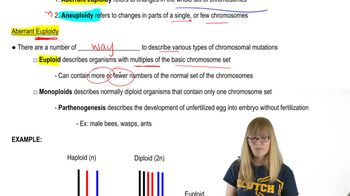
Aberrant Euploid

Karyotyping and Cytogenetic Analysis

Karyotyping is a laboratory technique that visualizes chromosomes under a microscope to detect numerical or structural abnormalities. Cytogenetic analysis allows researchers to correlate observed mutant phenotypes with specific chromosomal changes by comparing normal and mutant chromosome sets.
Video consigliato:
Percorso guidato
02:48
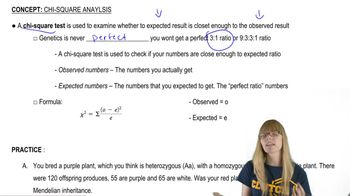
Chi Square Analysis

Genotype-Phenotype Correlation

Genotype-phenotype correlation involves linking specific genetic changes, such as chromosomal mutations, to observable traits or phenotypes. By studying inheritance patterns and molecular markers, scientists can determine if a mutant phenotype results from chromosomal alterations.
Video consigliato:
Percorso guidato
07:52
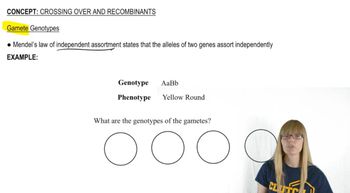
Gamete Genotypes