Ch. 6 - Chromosome Mutations: Variation in Number and Arrangement
Klug - Essentials of Genetics 10th Edition
Klug10th EditionEssentials of GeneticsISBN: 9780135588789Non è quello che usi tu?Cambia libro di testo
Capitolo 6, Problema 1d

How do we know that the mutant Bar-eye phenotype in Drosophila is due to a duplicated gene region rather than to a change in the nucleotide sequence of a gene?

Guida verificata passo dopo passo
1
Understand the nature of the Bar-eye phenotype in Drosophila, which is characterized by a reduced number of facets in the compound eye, suggesting a structural change rather than a simple point mutation.
Review genetic and cytogenetic evidence: examine chromosome banding patterns under a microscope to detect duplications or rearrangements in the region associated with the Bar-eye phenotype.
Analyze genetic crosses and inheritance patterns; a duplication often shows dosage effects and can produce dominant phenotypes, whereas a point mutation typically behaves differently in inheritance.
Use molecular techniques such as Southern blotting or DNA sequencing to compare the mutant and wild-type alleles; if the nucleotide sequence is unchanged but the gene copy number is increased, this supports duplication.
Consider gene dosage effects: increased gene copy number from duplication leads to overexpression, which correlates with the Bar-eye phenotype, whereas a nucleotide change would alter gene function without changing copy number.

Risposta video verificata per un problema simile:

Questa soluzione video è stata consigliata dai nostri tutor come utile per risolvere questo problema.
Durata del video:
1m

Concetti chiave

Ecco i concetti essenziali che devi comprendere per rispondere correttamente alla domanda.

Gene Duplication

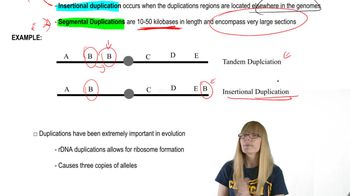
Gene duplication occurs when a segment of DNA containing a gene is copied one or more times in the genome. This can lead to increased gene dosage and altered phenotypes, such as the Bar-eye in Drosophila, where extra copies of a gene region cause changes in eye shape.
Video consigliato:

Mutation Types: Structural vs. Sequence Changes

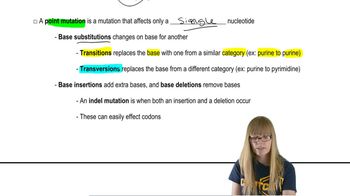
Mutations can involve changes in the DNA sequence (point mutations) or structural changes like duplications, deletions, or inversions. Distinguishing between these helps identify whether a phenotype arises from altered gene function or gene copy number.
Video consigliato:
Percorso guidato
09:49
Point Mutations

Genetic and Cytogenetic Evidence

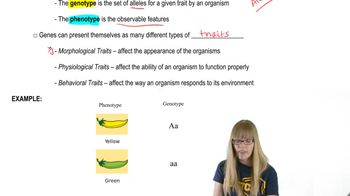
Techniques such as genetic mapping, complementation tests, and cytogenetic analysis (e.g., chromosome banding or in situ hybridization) can reveal duplications by showing extra chromosomal material or altered gene dosage, differentiating duplication from simple nucleotide changes.
Video consigliato:
Percorso guidato
03:45
Descriptive Genetics