Ch. 2 - Transmission Genetics
Sanders - Genetic Analysis: An Integrated Approach 3rd Edition
Sanders3rd EditionGenetic Analysis: An Integrated ApproachISBN: 9780135564172Non è quello che usi tu?Cambia libro di testo
Capitolo 2, Problema 48b

A pea plant that has the genotype RrGgwwdd is crossed to a plant that has the rrGgWwDd genotype. The R gene controls round versus wrinkled seed, the G gene controls yellow versus green seed, the W gene controls purple versus white flower, and the D gene controls tall versus short plants. Determine the following;


What proportion of the progeny are expected to have the genotype RrGGwwDd?

Guida verificata passo dopo passo
1
Identify the genotypes of the parent plants: The first parent has the genotype RrGgwwdd, and the second parent has the genotype rrGgWwDd. Each gene is inherited independently, so we will analyze each gene separately using the rules of Mendelian inheritance.
Determine the inheritance pattern for the R gene: The first parent is Rr (heterozygous), and the second parent is rr (homozygous recessive). Use a Punnett square to determine the possible offspring genotypes for this gene. The possible outcomes are Rr and rr, each with a probability of 1/2.
Determine the inheritance pattern for the G gene: Both parents are Gg (heterozygous). Use a Punnett square to determine the possible offspring genotypes for this gene. The possible outcomes are GG (1/4), Gg (1/2), and gg (1/4).
Determine the inheritance pattern for the W gene: The first parent is ww (homozygous recessive), and the second parent is Ww (heterozygous). Use a Punnett square to determine the possible offspring genotypes for this gene. The possible outcomes are Ww (1/2) and ww (1/2).
Determine the inheritance pattern for the D gene: The first parent is dd (homozygous recessive), and the second parent is Dd (heterozygous). Use a Punnett square to determine the possible offspring genotypes for this gene. The possible outcomes are Dd (1/2) and dd (1/2). Multiply the probabilities for each gene to find the proportion of progeny with the genotype RrGGwwDd: (1/2 for Rr) × (1/4 for GG) × (1/2 for ww) × (1/2 for Dd).

Risposta video verificata per un problema simile:

Questa soluzione video è stata consigliata dai nostri tutor come utile per risolvere questo problema.
Durata del video:
3m

Concetti chiave

Ecco i concetti essenziali che devi comprendere per rispondere correttamente alla domanda.

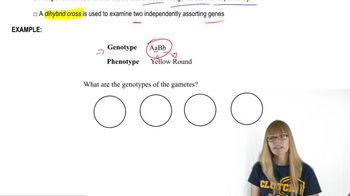
Genotype and Phenotype

The genotype refers to the genetic makeup of an organism, represented by alleles (e.g., Rr, Gg). The phenotype is the observable physical or biochemical characteristics resulting from the genotype. Understanding the relationship between genotype and phenotype is crucial for predicting traits in offspring.
Video consigliato:
Percorso guidato
07:52
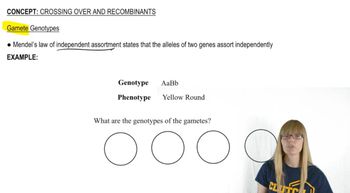
Gamete Genotypes

Punnett Square

A Punnett square is a diagram used to predict the genetic outcomes of a cross between two organisms. It helps visualize the combination of alleles from each parent, allowing for the calculation of the expected proportions of different genotypes and phenotypes in the progeny.
Video consigliato:
Percorso guidato
18:27
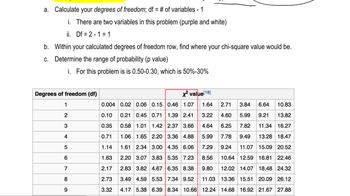
Chi Square Analysis

Independent Assortment

Independent assortment is a principle of genetics stating that alleles for different traits segregate independently during gamete formation. This means that the inheritance of one trait does not affect the inheritance of another, which is essential for calculating the probabilities of multiple traits in offspring.
Video consigliato:
Percorso guidato
04:58
Gamete Genetics and Independent Assortment
Pratica correlata
Domanda del libro di testo

The accompanying pedigree shows a family in which one child (II-1) has an autosomal recessive condition. On the basis of this fact alone, provide the following information.

What is the chance that among the three children in generation II who have the dominant phenotype, one of them is AA and two of them are Aa? (Hint: Consider all possible orders of genotypes.)

979
views
Domanda del libro di testo

A pea plant that has the genotype RrGgwwdd is crossed to a plant that has the rrGgWwDd genotype. The R gene controls round versus wrinkled seed, the G gene controls yellow versus green seed, the W gene controls purple versus white flower, and the D gene controls tall versus short plants. Determine the following;


What proportion of the progeny are expected to have the genotype rrggwwdd?

487
views
Domanda del libro di testo

A pea plant that has the genotype RrGgwwdd is crossed to a plant that has the rrGgWwDd genotype. The R gene controls round versus wrinkled seed, the G gene controls yellow versus green seed, the W gene controls purple versus white flower, and the D gene controls tall versus short plants. Determine the following;


What are the phenotypes of each plant?

575
views
Domanda del libro di testo

Go to the OMIM website (http://www.ncbi.nlm.nih.gov/omim) and locate the Search button at the top of the page. Use the search function to look up, one by one, the following three human hereditary diseases that are relatively common in certain populations: 'Tay–Sachs disease' (select OMIM number 272800 from the search results list); 'cystic fibrosis' (select OMIM number 602421 from the search results list); and 'sickle cell anemia' (select OMIM 603903 from the search results list). For each of these diseases, look through the information and provide the following details:

On which chromosome is the gene for the disease located?

608
views
Domanda del libro di testo

The accompanying pedigree shows a family in which one child (II-1) has an autosomal recessive condition. On the basis of this fact alone, provide the following information.

What is the probability that all three of the children in generation II who have the dominant phenotype are Aa?

917
views
Domanda del libro di testo

A pea plant that has the genotype RrGgwwdd is crossed to a plant that has the rrGgWwDd genotype. The R gene controls round versus wrinkled seed, the G gene controls yellow versus green seed, the W gene controls purple versus white flower, and the D gene controls tall versus short plants. Determine the following:

What proportion of the progeny are expected to be round, yellow, purple, and tall?

496
views