Indietro
Problema B.10
Suppose a man and a woman are each heterozygous carriers of a mutation causing a fatal hereditary disease not on the RUSP list. Prenatal genetic testing can identify the genotype of a fetus with regard to this disease and can identify fetuses with the disease. What do you think are the three or four most important factors this couple should consider in their decision making about having children?
Problema 11a
Consider translation of the following mRNA sequence:
5′-...AUGCAGAUCCAUGCCUAUUGA...-3′
Diagram translation at the moment the fourth amino acid is added to the polypeptide chain. Show the ribosome; label its A, P, and E sites; show its direction of movement; and indicate the position and anticodon triplet sequence of tRNAs that are currently interacting with mRNA codons.
Problema 11b
Consider translation of the following mRNA sequence:
5′-...AUGCAGAUCCAUGCCUAUUGA...-3′
What is the anticodon triplet sequence of the next tRNA to interact with mRNA?
Problema 11c
Consider translation of the following mRNA sequence:
5′-...AUGCAGAUCCAUGCCUAUUGA...-3′
What events occur to permit the next tRNA to interact with mRNA?
Problema B.12b
If you were to look up Gaucher disease on the OMIM website, you would see that there are three major types, designated Type I (OMIM 230800), Type II (OMIM 230900), and Type III (OMIM 231000). All three types are mutations of the gene for acid-β-glucosidase, encoded on chromosome 1. Different mutations of this gene produce the three types of Gaucher disease that differ somewhat in their symptoms and disease severity.
Thinking about the production or function of the acid-β-glucosidase enzyme, why do you suppose different mutations of this gene produce differences in symptoms and disease severity?
Problema B.12a
If you were to look up Gaucher disease on the OMIM website, you would see that there are three major types, designated Type I (OMIM 230800), Type II (OMIM 230900), and Type III (OMIM 231000). All three types are mutations of the gene for acid-β-glucosidase, encoded on chromosome 1. Different mutations of this gene produce the three types of Gaucher disease that differ somewhat in their symptoms and disease severity.
For each mutation, speculate about whether the acid-β-glucosidase enzyme is merely reduced in function or whether its production is eliminated, and explain why.
Problema 12a
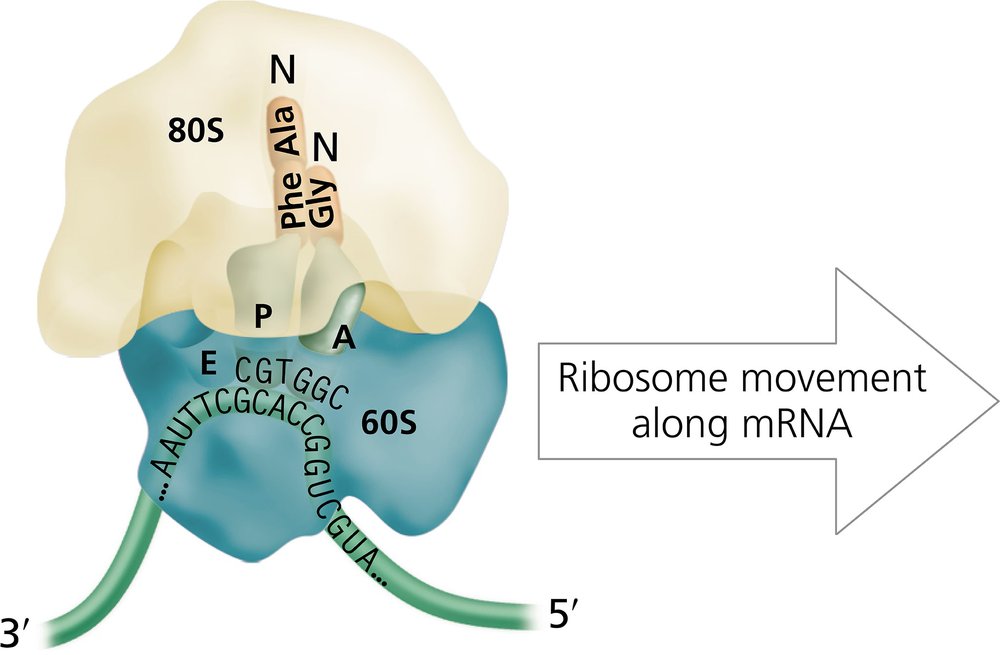
The diagram of a eukaryotic ribosome shown below contains several errors.
Examine the diagram carefully, and identify each error.
Problema 12b
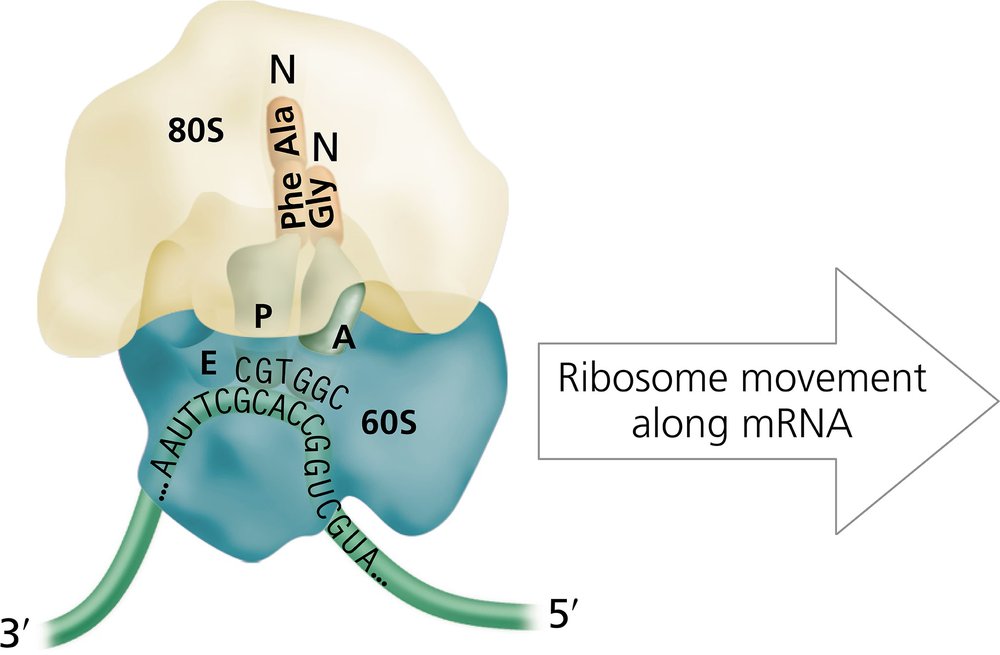
The diagram of a eukaryotic ribosome shown below contains several errors.
Redraw the diagram, and correct each error using the mRNA sequence shown.
Problema 13a
Third-base wobble allows some tRNAs to recognize more than one mRNA codon. Based on this chapter's discussion of wobble, what is the minimal number of tRNA molecules necessary to recognize the following amino acids?
Leucine
Problema 13b
Third-base wobble allows some tRNAs to recognize more than one mRNA codon. Based on this chapter's discussion of wobble, what is the minimal number of tRNA molecules necessary to recognize the following amino acids?
Arginine
Problema 13c
Third-base wobble allows some tRNAs to recognize more than one mRNA codon. Based on this chapter's discussion of wobble, what is the minimal number of tRNA molecules necessary to recognize the following amino acids?
Isoleucine
Problema 13d
Third-base wobble allows some tRNAs to recognize more than one mRNA codon. Based on this chapter's discussion of wobble, what is the minimal number of tRNA molecules necessary to recognize the following amino acids?
Lysine
Problema 14
The genetic code contains 61 codons to specify the 20 common amino acids. Many organisms carry fewer than 61 different tRNA genes in their genomes. These genomes take advantage of isoaccepting tRNAs and the rules governing third-base wobble to encode fewer than 61 tRNA genes. Use these rules to calculate the minimal number of tRNA genes required to specify all 20 of the common amino acids.
Problema 15a
The three major forms of RNA (mRNA, tRNA, and rRNA) interact during translation.
Describe the role each form of RNA performs during translation.
Problema 15b
The three major forms of RNA (mRNA, tRNA, and rRNA) interact during translation.
Which of the three types of RNA might you expect to be the least stable? Why?
Problema 15c
The three major forms of RNA (mRNA, tRNA, and rRNA) interact during translation.
Which form of RNA is least stable in eukaryotes? Why is this form least stable?
Problema 15d
The three major forms of RNA (mRNA, tRNA, and rRNA) interact during translation.
Compared to the average stability of mRNA in E. coli, is mRNA in a typical human cell more stable or less stable? Why?
Problema 16
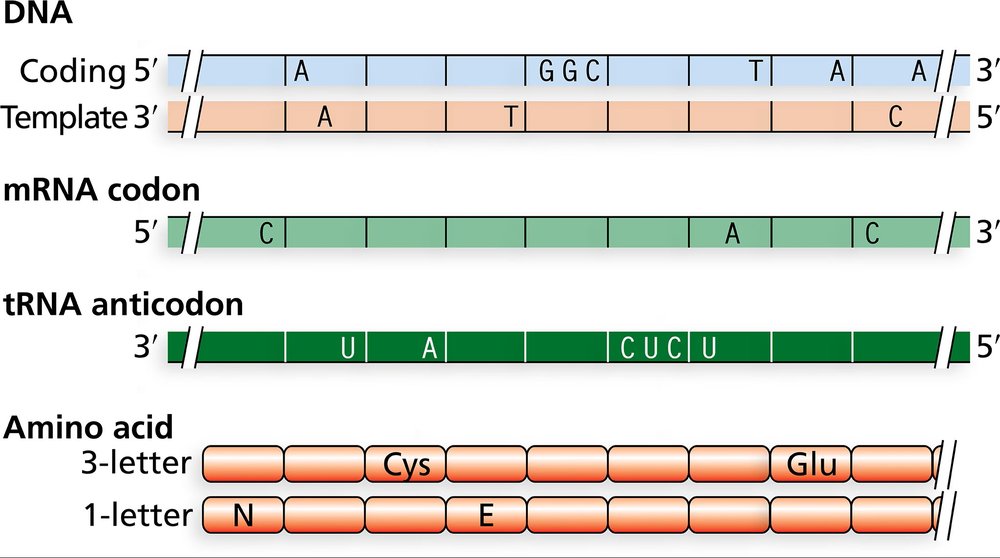
The accompanying figure contains sufficient information to fill in every row. Use the information provided to complete the figure.
Problema 17
The line below represents a mature eukaryotic mRNA. The accompanying list contains many sequences or structures that are part of eukaryotic mRNA. A few of the items in the list, however, are not found in eukaryotic mRNA. As accurately as you can, show the location, on the line, of the sequences or structures that belong in eukaryotic mRNA; then, separately, list the items that are not part of eukaryotic mRNA.
5′ ____________________________ 3′
a. stop codon
b. poly-A tail
c. intron
d. 3' UTR
e. promoter
f. start codon
g. AAUAAA
h. 5' UTR
i. 5' cap
j. termination sequenceProblema 18
After completing Problem 17, carefully draw a line below the mRNA to represent its polypeptide product in accurate alignment with the mRNA. Label the N-terminal and C-terminal ends of the polypeptide. Carefully draw two lines above and parallel to the mRNA, and label them 'coding strand' and 'template strand.' Locate the DNA promoter sequence. Identify the locations of the nucleotide and of a transcription termination sequence.
Problema 19
Define and describe the differences in the primary, secondary, and tertiary structures of a protein.
Problema 20a
Describe the roles and relationships between tRNA synthetases and tRNA molecules.
Problema 20b
Describe the roles and relationships between tRNA anticodon sequences and mRNA codon sequences.
Problema 21a
In an experiment to decipher the genetic code, a poly-AC mRNA (ACACACAC...) is synthesized. What pattern of amino acids would appear if this sequence were to be translated by a mechanism that reads the genetic code as
A doublet without overlaps?
Problema 21b
In an experiment to decipher the genetic code, a poly-AC mRNA (ACACACAC...) is synthesized. What pattern of amino acids would appear if this sequence were to be translated by a mechanism that reads the genetic code as
A doublet with overlaps?
Problema 21c
In an experiment to decipher the genetic code, a poly-AC mRNA (ACACACAC...) is synthesized. What pattern of amino acids would appear if this sequence were to be translated by a mechanism that reads the genetic code as
A triplet without overlaps?
Problema 21d
In an experiment to decipher the genetic code, a poly-AC mRNA (ACACACAC...) is synthesized. What pattern of amino acids would appear if this sequence were to be translated by a mechanism that reads the genetic code as
A triplet with overlaps?
Problema 21e
In an experiment to decipher the genetic code, a poly-AC mRNA (ACACACAC...) is synthesized. What pattern of amino acids would appear if this sequence were to be translated by a mechanism that reads the genetic code as
A quadruplet without overlaps?
Problema 21f
In an experiment to decipher the genetic code, a poly-AC mRNA (ACACACAC...) is synthesized. What pattern of amino acids would appear if this sequence were to be translated by a mechanism that reads the genetic code as
A quadruplet with overlaps?
Problema 22
Identify and describe the steps that lead to the secretion of proteins from eukaryotic cells.