Ch.18 Amino Acids and Proteins
McMurry - Fundamentals of General, Organic, and Biological Chemistry 8th Edition
McMurry8th EditionFundamentals of General, Organic, and Biological ChemistryISBN: 9780134015187Non è quello che usi tu?Cambia libro di testo
Capitolo 18, Problema 93a

Explain how a protein is denatured by the following:
a. Heat

Guida verificata passo dopo passo
1
Understand the concept of protein denaturation: Denaturation is the process by which a protein loses its native three-dimensional structure due to the disruption of non-covalent interactions (e.g., hydrogen bonds, ionic bonds, hydrophobic interactions) and sometimes covalent bonds (e.g., disulfide bridges). This process does not break peptide bonds, so the primary structure remains intact.
Recognize the role of heat in denaturation: Heat provides energy that disrupts the weak non-covalent interactions holding the protein's secondary, tertiary, and quaternary structures together. These interactions are sensitive to temperature changes.
Describe the mechanism of heat-induced denaturation: As the temperature increases, the kinetic energy of the protein molecules increases. This causes the molecules to vibrate more vigorously, breaking hydrogen bonds and other stabilizing interactions. This leads to the unfolding of the protein's structure.
Explain the consequences of denaturation: When the protein unfolds, it loses its specific shape, which is critical for its biological function. This loss of structure results in the loss of the protein's activity.
Provide an example: For instance, when an egg is cooked, the heat denatures the proteins in the egg white (mainly albumin), causing them to unfold and aggregate, which changes the egg white from a clear liquid to a solid white mass.

Risposta video verificata per un problema simile:

Questa soluzione video è stata consigliata dai nostri tutor come utile per risolvere questo problema.

Concetti chiave

Ecco i concetti essenziali che devi comprendere per rispondere correttamente alla domanda.

Protein Structure

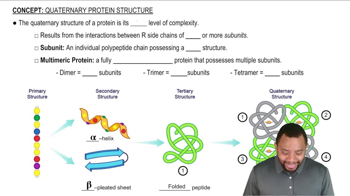
Proteins are composed of long chains of amino acids that fold into specific three-dimensional shapes. This structure is crucial for their function and is organized into four levels: primary (amino acid sequence), secondary (alpha helices and beta sheets), tertiary (overall 3D shape), and quaternary (multiple polypeptide chains). Understanding these levels is essential to grasp how denaturation affects protein functionality.
Video consigliato:
Percorso guidato
3:26
Quaternary Protein Structure Concept 1

Denaturation

Denaturation refers to the process where proteins lose their native structure due to external stressors, such as heat, pH changes, or chemicals. This alteration disrupts the non-covalent interactions (like hydrogen bonds and hydrophobic interactions) that maintain the protein's shape, leading to a loss of biological activity. Denatured proteins may aggregate or precipitate, further impacting their function.
Video consigliato:
Percorso guidato
1:17
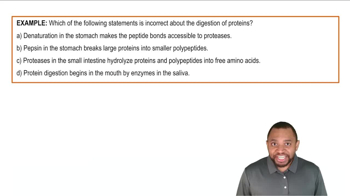
Digestion of Proteins Example 1

Effects of Heat on Proteins

Heat can cause proteins to denature by increasing molecular motion, which disrupts the weak interactions holding the protein's structure together. As temperature rises, the kinetic energy of the molecules increases, leading to the unfolding of the protein. This process is often irreversible, meaning that once a protein is denatured by heat, it may not regain its original structure or function.
Video consigliato: