Ch.18 Amino Acids and Proteins
McMurry - Fundamentals of General, Organic, and Biological Chemistry 8th Edition
McMurry8th EditionFundamentals of General, Organic, and Biological ChemistryISBN: 9780134015187Non è quello che usi tu?Cambia libro di testo
Capitolo 18, Problema 87b

How do the following interactions help to stabilize the tertiary and quaternary structure of a protein? Give an example of a pair of amino acids that could give rise to each interaction.
b. Disulfide bonds

Guida verificata passo dopo passo
1
Understand the concept of disulfide bonds: Disulfide bonds are covalent bonds formed between the sulfur atoms of two cysteine amino acid residues. These bonds help stabilize the three-dimensional structure of proteins by creating strong links between different parts of the polypeptide chain or between different polypeptide chains in a protein complex.
Recognize the role of disulfide bonds in protein structure: In the tertiary structure, disulfide bonds stabilize the folding of a single polypeptide chain by connecting distant regions of the chain. In the quaternary structure, they can stabilize the association of multiple polypeptide chains into a functional protein complex.
Identify the amino acids involved: The amino acid cysteine is the only one capable of forming disulfide bonds due to the presence of a thiol group (-SH) in its side chain. When two cysteine residues come into close proximity, their thiol groups can undergo oxidation to form a disulfide bond (S-S).
Provide an example: A pair of cysteine residues within a single polypeptide chain or between two chains can form a disulfide bond. For instance, in the hormone insulin, disulfide bonds link the A and B chains of the protein, contributing to its quaternary structure.
Summarize the stabilization effect: Disulfide bonds contribute to the stability of the protein by reducing the flexibility of the polypeptide chain and maintaining the protein's functional conformation under various environmental conditions, such as changes in pH or temperature.

Risposta video verificata per un problema simile:

Questa soluzione video è stata consigliata dai nostri tutor come utile per risolvere questo problema.

Concetti chiave

Ecco i concetti essenziali che devi comprendere per rispondere correttamente alla domanda.

Disulfide Bonds

Disulfide bonds are covalent linkages formed between the sulfur atoms of two cysteine amino acids. These bonds play a crucial role in stabilizing the tertiary and quaternary structures of proteins by creating strong connections that help maintain the protein's three-dimensional shape. For example, when two cysteine residues are in proximity, they can undergo oxidation to form a disulfide bond, which significantly enhances the structural integrity of the protein.
Video consigliato:

Tertiary Structure

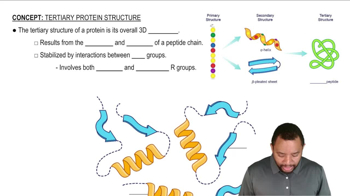
The tertiary structure of a protein refers to its overall three-dimensional shape, formed by the folding and interactions of its polypeptide chain. This structure is stabilized by various interactions, including hydrogen bonds, ionic bonds, hydrophobic interactions, and disulfide bonds. The specific arrangement of amino acids and their side chains determines how the protein folds, which is essential for its function.
Video consigliato:
Percorso guidato
2:07
Tertiary Protein Structure Concept 1

Quaternary Structure

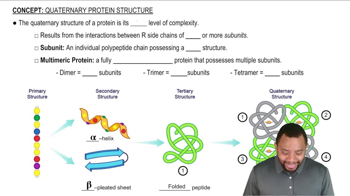
Quaternary structure is the assembly of multiple polypeptide chains into a single functional protein complex. This structure is stabilized by various interactions, including disulfide bonds, which can link different polypeptide chains together. An example is hemoglobin, which consists of four polypeptide subunits, and the interactions between these subunits are critical for its ability to transport oxygen in the blood.
Video consigliato:
Percorso guidato
3:26
Quaternary Protein Structure Concept 1