Ch.18 Amino Acids and Proteins
McMurry - Fundamentals of General, Organic, and Biological Chemistry 8th Edition
McMurry8th EditionFundamentals of General, Organic, and Biological ChemistryISBN: 9780134015187Non è quello che usi tu?Cambia libro di testo
Capitolo 18, Problema 89

Give an example of a protein that has quaternary structure. How many polypeptide chains are present in this protein?

Guida verificata passo dopo passo
1
Step 1: Understand the concept of quaternary structure. Proteins with quaternary structure are composed of two or more polypeptide chains (subunits) that are held together by non-covalent interactions or, in some cases, covalent bonds. These subunits work together to form a functional protein complex.
Step 2: Identify an example of a protein with quaternary structure. Hemoglobin is a well-known example of a protein with quaternary structure. It is responsible for transporting oxygen in the blood.
Step 3: Determine the number of polypeptide chains in hemoglobin. Hemoglobin consists of four polypeptide chains: two alpha (α) chains and two beta (β) chains.
Step 4: Recognize the significance of the quaternary structure in hemoglobin. The arrangement of the four subunits allows hemoglobin to efficiently bind and release oxygen molecules, demonstrating the functional importance of quaternary structure.
Step 5: Conclude that hemoglobin is an example of a protein with quaternary structure, and it contains four polypeptide chains in total.

Risposta video verificata per un problema simile:

Questa soluzione video è stata consigliata dai nostri tutor come utile per risolvere questo problema.

Concetti chiave

Ecco i concetti essenziali che devi comprendere per rispondere correttamente alla domanda.

Quaternary Structure

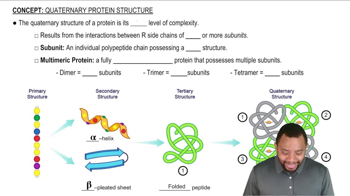
Quaternary structure refers to the highest level of protein organization, where multiple polypeptide chains, known as subunits, come together to form a functional protein complex. This structure is stabilized by various interactions, including hydrogen bonds, ionic bonds, and hydrophobic interactions. An example of a protein with quaternary structure is hemoglobin, which consists of four polypeptide chains.
Video consigliato:
Percorso guidato
3:26
Quaternary Protein Structure Concept 1

Polypeptide Chains

Polypeptide chains are long sequences of amino acids linked by peptide bonds, forming the primary structure of proteins. The number of polypeptide chains in a protein can vary, and in the case of quaternary structure, multiple chains interact to create a functional unit. For instance, hemoglobin has two alpha and two beta polypeptide chains, totaling four chains.
Video consigliato:
Percorso guidato
3:10
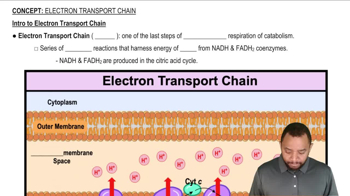
Intro to Electron Transport Chain Concept 1

Protein Functionality

The functionality of a protein is closely tied to its structure, including its quaternary arrangement. The specific interactions between polypeptide chains can affect the protein's stability, activity, and ability to bind to other molecules. Understanding how these structures contribute to function is crucial in fields like biochemistry and molecular biology, as it helps explain how proteins perform their roles in biological systems.
Video consigliato:
Percorso guidato
02:16
Logarithmic Functions