Ch.18 Amino Acids and Proteins
McMurry - Fundamentals of General, Organic, and Biological Chemistry 8th Edition
McMurry8th EditionFundamentals of General, Organic, and Biological ChemistryISBN: 9780134015187Non è quello che usi tu?Cambia libro di testo
Capitolo 18, Problema 93b

Explain how a protein is denatured by the following:
b. Strong acids

Guida verificata passo dopo passo
1
Understand the concept of protein denaturation: Denaturation is the process by which a protein loses its native three-dimensional structure due to the disruption of non-covalent interactions, such as hydrogen bonds, ionic bonds, and hydrophobic interactions, without breaking its primary structure (sequence of amino acids).
Recognize the role of strong acids: Strong acids, such as HCl, can denature proteins by altering the pH of the environment. This change in pH affects the ionization of amino acid side chains, particularly those with acidic or basic groups.
Explain the disruption of ionic bonds: At low pH, the excess H⁺ ions from the strong acid can protonate negatively charged side chains (e.g., carboxylate groups, -COO⁻, become -COOH). This disrupts ionic bonds between oppositely charged side chains, destabilizing the protein's tertiary and quaternary structures.
Describe the effect on hydrogen bonding: The altered ionization of side chains can also interfere with hydrogen bonding patterns within the protein, further contributing to the loss of its native structure.
Summarize the outcome: As a result of these disruptions, the protein unfolds or aggregates, losing its functional shape. This process is irreversible in most cases, and the protein can no longer perform its biological function.

Risposta video verificata per un problema simile:

Questa soluzione video è stata consigliata dai nostri tutor come utile per risolvere questo problema.

Concetti chiave

Ecco i concetti essenziali che devi comprendere per rispondere correttamente alla domanda.

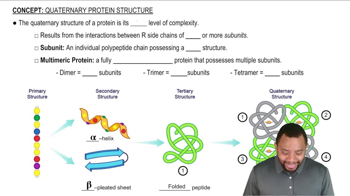
Protein Structure

Proteins are composed of long chains of amino acids that fold into specific three-dimensional structures. These structures are crucial for their function and are categorized into four levels: primary, secondary, tertiary, and quaternary. The stability of these structures is maintained by various interactions, including hydrogen bonds, ionic bonds, and hydrophobic interactions.
Video consigliato:
Percorso guidato
3:26
Quaternary Protein Structure Concept 1

Denaturation

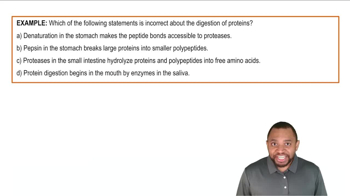
Denaturation refers to the process where a protein loses its native structure due to external stressors, such as heat, pH changes, or chemical agents. This alteration disrupts the interactions that maintain the protein's shape, leading to a loss of function. Denatured proteins may aggregate or precipitate, which can be irreversible in some cases.
Video consigliato:
Percorso guidato
1:17
Digestion of Proteins Example 1

Effect of Strong Acids

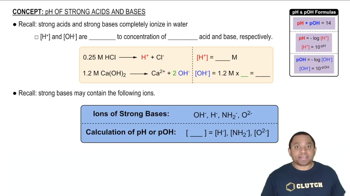
Strong acids can denature proteins by significantly lowering the pH of the environment, which disrupts ionic and hydrogen bonds that stabilize the protein structure. This change in pH can lead to the protonation of amino acid side chains, altering their charge and interactions. As a result, the protein unfolds and loses its functional conformation.
Video consigliato:
Percorso guidato
02:39
Strong Acids and Bases