Ch.12 Alcohols, Thiols, Ethers, Aldehydes, and Ketones
Timberlake - Chemistry: An Introduction to General, Organic, and Biological Chemistry 13th Edition
Timberlake13th EditionChemistry: An Introduction to General, Organic, and Biological ChemistryISBN: 9780134421353Non è quello che usi tu?Cambia libro di testo
Capitolo 12, Problema 13b

Give an explanation for each of the following observations:
b. 1-Propanol is soluble in water, but ethyl methyl ether is only slightly soluble.

Guida verificata passo dopo passo
1
1. Begin by identifying the molecular structures of 1-propanol and ethyl methyl ether. 1-propanol (C3H8O) contains a hydroxyl (-OH) group, while ethyl methyl ether (C3H8O) contains an ether (-O-) functional group.
2. Explain the concept of hydrogen bonding. The hydroxyl group in 1-propanol can form hydrogen bonds with water molecules because the oxygen atom is highly electronegative, creating a partial negative charge, and the hydrogen atom attached to it has a partial positive charge.
3. Discuss the solubility of 1-propanol in water. The ability of 1-propanol to form hydrogen bonds with water molecules significantly increases its solubility in water, as these interactions help integrate the alcohol into the aqueous environment.
4. Explain the solubility of ethyl methyl ether in water. Ethyl methyl ether lacks a hydroxyl group and cannot form hydrogen bonds with water. While it can interact with water through weaker dipole-dipole interactions due to the oxygen atom, these interactions are insufficient to make it highly soluble.
5. Conclude by comparing the two molecules. The presence of the hydroxyl group in 1-propanol allows for stronger intermolecular interactions with water (hydrogen bonding), making it more soluble than ethyl methyl ether, which relies only on weaker dipole-dipole interactions.

Risposta video verificata per un problema simile:

Questa soluzione video è stata consigliata dai nostri tutor come utile per risolvere questo problema.

Concetti chiave

Ecco i concetti essenziali che devi comprendere per rispondere correttamente alla domanda.

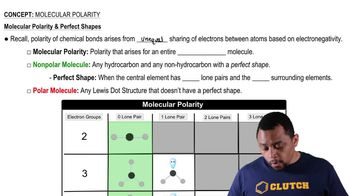
Polarity

Polarity refers to the distribution of electrical charge over the atoms in a molecule. Molecules with a significant difference in electronegativity between their atoms, like water (H2O), are polar and can form hydrogen bonds. 1-Propanol, which has a hydroxyl (-OH) group, is polar and can interact favorably with water, enhancing its solubility.
Video consigliato:
Percorso guidato
01:34
Molecular Polarity (Simplified) Concept 1

Hydrogen Bonding

Hydrogen bonding is a type of strong dipole-dipole attraction that occurs between molecules when hydrogen is bonded to highly electronegative atoms like oxygen or nitrogen. In the case of 1-propanol, the -OH group allows it to form hydrogen bonds with water molecules, leading to its high solubility. In contrast, ethyl methyl ether lacks such strong hydrogen bonding capabilities, resulting in its lower solubility.
Video consigliato:
Percorso guidato
1:22
Hydrogenation Reactions Concept 1

Molecular Structure

The molecular structure of a compound, including its functional groups and overall shape, significantly influences its solubility in water. 1-Propanol has a straight-chain structure with a polar hydroxyl group, making it more compatible with water. Ethyl methyl ether, however, has an ether functional group that is less polar, contributing to its limited solubility in water.
Video consigliato:
Percorso guidato
00:34
Molecular Models Example 1