Ch.17 Nucleic Acids and Protein Synthesis
Timberlake - Chemistry: An Introduction to General, Organic, and Biological Chemistry 13th Edition
Timberlake13th EditionChemistry: An Introduction to General, Organic, and Biological ChemistryISBN: 9780134421353Non è quello che usi tu?Cambia libro di testo
Capitolo 17, Problema 25

How are the two strands of nucleic acid in DNA held together?

Guida verificata passo dopo passo
1
Understand that DNA is composed of two strands forming a double helix structure. These strands are made up of nucleotides, which consist of a sugar, a phosphate group, and a nitrogenous base.
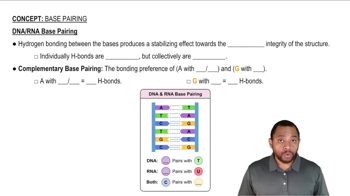
Recognize that the two strands of DNA are held together by hydrogen bonds between complementary nitrogenous bases. These bases are adenine (A), thymine (T), cytosine (C), and guanine (G).
Learn the base-pairing rules: adenine (A) pairs with thymine (T) through two hydrogen bonds, and cytosine (C) pairs with guanine (G) through three hydrogen bonds.
Note that the hydrogen bonds are relatively weak individually, but collectively they provide stability to the DNA double helix while still allowing the strands to separate during processes like replication and transcription.
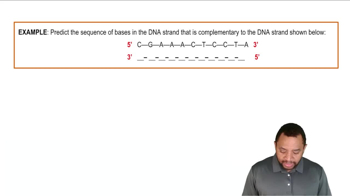
Understand that the strands are also oriented in opposite directions (antiparallel), with one strand running 5' to 3' and the other running 3' to 5', which is crucial for the structure and function of DNA.

Risposta video verificata per un problema simile:

Questa soluzione video è stata consigliata dai nostri tutor come utile per risolvere questo problema.
Durata del video:
4m

Concetti chiave

Ecco i concetti essenziali che devi comprendere per rispondere correttamente alla domanda.

Base Pairing

Base pairing is a fundamental concept in molecular biology that describes how nucleotides in DNA connect to form the double helix structure. Adenine (A) pairs with thymine (T), and cytosine (C) pairs with guanine (G) through hydrogen bonds. This specific pairing ensures accurate replication and transcription of genetic information.
Video consigliato:
Percorso guidato
2:56
Base Pairing Concept 1

Hydrogen Bonds

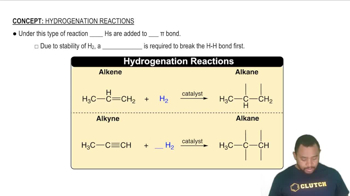
Hydrogen bonds are weak interactions that occur between the hydrogen atom of one molecule and an electronegative atom of another. In DNA, these bonds form between the nitrogenous bases of the two strands, stabilizing the double helix structure. Although individually weak, the cumulative effect of many hydrogen bonds provides significant stability to the DNA molecule.
Video consigliato:
Percorso guidato
1:22
Hydrogenation Reactions Concept 1

Antiparallel Strands

The antiparallel nature of DNA refers to the orientation of the two strands that make up the double helix. One strand runs in a 5' to 3' direction, while the other runs 3' to 5'. This orientation is crucial for the mechanisms of DNA replication and transcription, as enzymes that interact with DNA recognize this directional arrangement.
Video consigliato:
Percorso guidato
1:49
DNA Double Helix Example 1