Ch.17 Nucleic Acids and Protein Synthesis
Timberlake - Chemistry: An Introduction to General, Organic, and Biological Chemistry 13th Edition
Timberlake13th EditionChemistry: An Introduction to General, Organic, and Biological ChemistryISBN: 9780134421353Non è quello che usi tu?Cambia libro di testo
Capitolo 17, Problema 23

List three structural characteristics of DNA.

Guida verificata passo dopo passo
1
DNA (Deoxyribonucleic Acid) is a double-stranded molecule, meaning it consists of two complementary strands that are coiled around each other to form a double helix structure.
The backbone of each DNA strand is composed of alternating sugar (deoxyribose) and phosphate groups, which are connected by phosphodiester bonds.
The interior of the DNA double helix contains nitrogenous bases (adenine, thymine, cytosine, and guanine) that pair specifically through hydrogen bonding: adenine pairs with thymine (A-T) and cytosine pairs with guanine (C-G).

Risposta video verificata per un problema simile:

Questa soluzione video è stata consigliata dai nostri tutor come utile per risolvere questo problema.
Durata del video:
3m

Concetti chiave

Ecco i concetti essenziali che devi comprendere per rispondere correttamente alla domanda.

Double Helix Structure

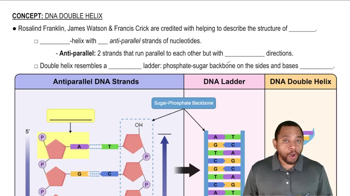
DNA is structured as a double helix, which consists of two long strands of nucleotides twisted around each other. This configuration provides stability and allows for the efficient storage of genetic information. The strands are held together by hydrogen bonds between complementary base pairs, which are adenine-thymine and guanine-cytosine.
Video consigliato:
Percorso guidato
3:27
DNA Double Helix Concept 1

Antiparallel Strands

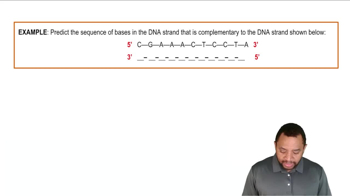
The two strands of DNA run in opposite directions, a feature known as antiparallel orientation. One strand runs from the 5' to 3' direction, while the other runs from 3' to 5'. This orientation is crucial for DNA replication and transcription, as enzymes that synthesize new strands can only add nucleotides to the 3' end.
Video consigliato:
Percorso guidato
1:49
DNA Double Helix Example 1

Base Pairing

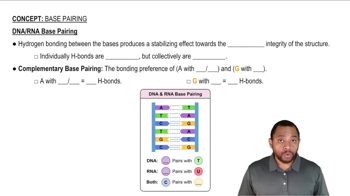
Base pairing refers to the specific hydrogen bonding between the nitrogenous bases of the two DNA strands. Adenine pairs with thymine (A-T) and guanine pairs with cytosine (G-C). This complementary base pairing is essential for the accurate replication of DNA and the transmission of genetic information during cell division.
Video consigliato:
Percorso guidato
2:56
Base Pairing Concept 1