Ch.17 Nucleic Acids and Protein Synthesis
Timberlake - Chemistry: An Introduction to General, Organic, and Biological Chemistry 13th Edition
Timberlake13th EditionChemistry: An Introduction to General, Organic, and Biological ChemistryISBN: 9780134421353Non è quello che usi tu?Cambia libro di testo
Capitolo 17, Problema 19

What component in a nucleic acid determines the 5' free end?

Guida verificata passo dopo passo
1
Understand that nucleic acids, such as DNA and RNA, have a directionality, which is indicated by the 5' and 3' ends.
Recognize that the 5' end of a nucleic acid strand refers to the end where the fifth carbon in the sugar ring of the nucleotide is free or unbound.
Identify that the sugar in nucleic acids is either ribose (in RNA) or deoxyribose (in DNA), and the 5' carbon is part of this sugar structure.
Note that the 5' end is typically characterized by a free phosphate group attached to the 5' carbon of the sugar.
Conclude that the presence of this free phosphate group at the 5' carbon of the sugar determines the 5' free end of a nucleic acid.

Risposta video verificata per un problema simile:

Questa soluzione video è stata consigliata dai nostri tutor come utile per risolvere questo problema.
Durata del video:
3m

Concetti chiave

Ecco i concetti essenziali che devi comprendere per rispondere correttamente alla domanda.

Nucleic Acid Structure

Nucleic acids, such as DNA and RNA, are polymers made up of nucleotide monomers. Each nucleotide consists of a phosphate group, a sugar, and a nitrogenous base. The structure of nucleic acids is directional, with a 5' end that has a phosphate group attached to the fifth carbon of the sugar, and a 3' end that has a hydroxyl group on the third carbon.
Video consigliato:
Percorso guidato
0:56
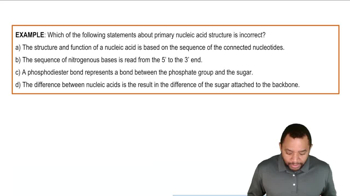
Primary Structure of Nucleic Acids Example 2

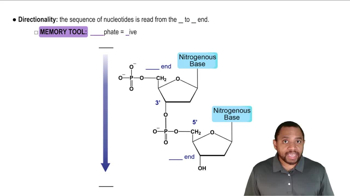
5' and 3' Ends

The terms 5' (five prime) and 3' (three prime) refer to the orientation of the sugar molecule in the nucleotide. The 5' end is characterized by the presence of a phosphate group, while the 3' end has a hydroxyl group. This directional notation is crucial for understanding the synthesis and function of nucleic acids, as they are synthesized in a 5' to 3' direction.
Video consigliato:
Percorso guidato
1:43
Primary Structure of Nucleic Acids Concept 2

Phosphate Group

The phosphate group is a key component of nucleotides that links them together to form the backbone of nucleic acids. It is attached to the 5' carbon of the sugar in a nucleotide, which defines the 5' free end of the nucleic acid strand. The presence of this phosphate group is essential for the structural integrity and function of nucleic acids.
Video consigliato:
Percorso guidato
2:26
Alkyl Groups Concept 1