Ch.18 Metabolic Pathways and ATP Production
Timberlake - Chemistry: An Introduction to General, Organic, and Biological Chemistry 13th Edition
Timberlake13th EditionChemistry: An Introduction to General, Organic, and Biological ChemistryISBN: 9780134421353Non è quello che usi tu?Cambia libro di testo
Capitolo 18, Problema 87

If there are no reactions in the citric acid cycle that use oxygen, O2, why does the cycle operate only in aerobic conditions?

Guida verificata passo dopo passo
1
Understand the context: The citric acid cycle (also known as the Krebs cycle) is a central metabolic pathway that generates high-energy molecules like NADH and FADH₂, which are later used in the electron transport chain (ETC) to produce ATP.
Recognize the role of oxygen: While the citric acid cycle itself does not directly use oxygen (O₂), the NADH and FADH₂ produced in the cycle are oxidized in the ETC, which requires oxygen as the final electron acceptor.
Connect the dependency: If oxygen is not available, the ETC cannot function. This leads to a buildup of NADH and FADH₂, which are not converted back to their oxidized forms (NAD⁺ and FAD). These oxidized forms are essential for the citric acid cycle to continue operating.
Explain the aerobic condition: Without oxygen, the lack of NAD⁺ and FAD halts the citric acid cycle because these molecules are required to accept electrons during the cycle's reactions.
Summarize the relationship: Although the citric acid cycle does not directly use oxygen, it depends on the availability of NAD⁺ and FAD, which are regenerated in the oxygen-dependent ETC. Therefore, the cycle operates only under aerobic conditions.

Risposta video verificata per un problema simile:

Questa soluzione video è stata consigliata dai nostri tutor come utile per risolvere questo problema.
Durata del video:
4m

Concetti chiave

Ecco i concetti essenziali che devi comprendere per rispondere correttamente alla domanda.

Citric Acid Cycle

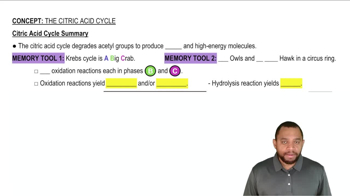
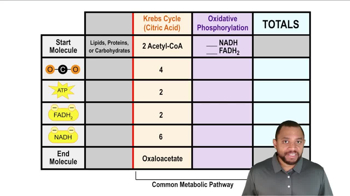
The citric acid cycle, also known as the Krebs cycle, is a series of enzymatic reactions that occur in the mitochondria, where acetyl-CoA is oxidized to produce energy carriers like NADH and FADH₂. Although it does not directly use oxygen, it is crucial for aerobic respiration, as it provides the reducing agents needed for the electron transport chain.
Video consigliato:
Percorso guidato
2:31
Citric Acid Cycle Summary Concept 12

Aerobic Conditions

Aerobic conditions refer to environments where oxygen is present, allowing organisms to perform cellular respiration efficiently. In these conditions, the electron transport chain can operate, utilizing the NADH and FADH₂ produced in the citric acid cycle to generate ATP through oxidative phosphorylation, which is essential for energy production.
Video consigliato:
Percorso guidato
2:46
Aerobic Respiration Summary Concept 1

Electron Transport Chain

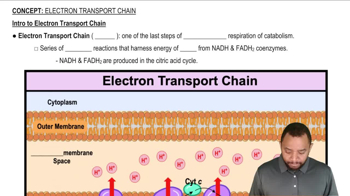
The electron transport chain (ETC) is a series of protein complexes located in the inner mitochondrial membrane that transfer electrons from NADH and FADH₂ to oxygen, forming water. This process creates a proton gradient that drives ATP synthesis. The citric acid cycle feeds into the ETC, linking its operation to the presence of oxygen, which is why the cycle is primarily active under aerobic conditions.
Video consigliato:
Percorso guidato
3:10
Intro to Electron Transport Chain Concept 1