
Ch.18 Metabolic Pathways and ATP Production
Timberlake - Chemistry: An Introduction to General, Organic, and Biological Chemistry 13th Edition
Timberlake13th EditionChemistry: An Introduction to General, Organic, and Biological ChemistryISBN: 9780134421353Non è quello che usi tu?Cambia libro di testo
Capitolo 18, Problema 89

In the chemiosmotic model, how is energy provided to synthesize ATP?

Guida verificata passo dopo passo
1
Understand the chemiosmotic model: The chemiosmotic model explains how ATP is synthesized in cells, particularly in mitochondria during cellular respiration and in chloroplasts during photosynthesis. It involves the movement of protons (H⁺ ions) across a membrane to create a proton gradient.
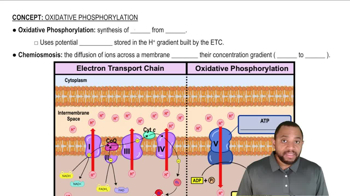
Identify the source of energy: Energy is provided by the electron transport chain (ETC), which is a series of protein complexes embedded in the inner mitochondrial membrane. As electrons are passed along the chain, energy is released and used to pump protons from the mitochondrial matrix into the intermembrane space, creating a proton gradient.
Describe the proton gradient: The proton gradient creates both a concentration difference (higher H⁺ concentration in the intermembrane space) and an electrical potential difference (positive charge in the intermembrane space and negative charge in the matrix). This combination is referred to as the proton motive force (PMF).
Explain ATP synthesis: Protons flow back into the mitochondrial matrix through ATP synthase, a protein complex that acts as a molecular turbine. The flow of protons down their gradient provides the energy needed for ATP synthase to catalyze the phosphorylation of ADP (adenosine diphosphate) to ATP (adenosine triphosphate).
Summarize the process: The energy for ATP synthesis is derived from the proton motive force, which is generated by the electron transport chain using energy from the oxidation of nutrients. This process is a key component of oxidative phosphorylation in cellular respiration.

Risposta video verificata per un problema simile:

Questa soluzione video è stata consigliata dai nostri tutor come utile per risolvere questo problema.
Durata del video:
1m

Concetti chiave

Ecco i concetti essenziali che devi comprendere per rispondere correttamente alla domanda.

Chemiosmosis

Chemiosmosis is the process by which ATP is produced in cells through the movement of protons (H+) across a membrane. This movement occurs down a concentration gradient, typically facilitated by ATP synthase, an enzyme that harnesses the energy from the flow of protons to convert ADP and inorganic phosphate into ATP.
Video consigliato:
Percorso guidato
2:37
Oxidative Phosphorylation Concept 1

Proton Gradient

A proton gradient is created when protons are pumped across a membrane, resulting in a higher concentration of protons on one side than the other. This gradient represents potential energy, which can be utilized by ATP synthase to drive the synthesis of ATP as protons flow back across the membrane into the area of lower concentration.
Video consigliato:
Percorso guidato
2:37
Oxidative Phosphorylation Concept 1

ATP Synthase

ATP synthase is a complex enzyme located in the inner mitochondrial membrane (or thylakoid membrane in chloroplasts) that catalyzes the formation of ATP. It operates by using the energy released from the flow of protons down their concentration gradient to convert ADP and inorganic phosphate into ATP, effectively linking the processes of electron transport and ATP production.
Video consigliato:
Percorso guidato
2:20
Adenosine Triphosphate (ATP) Concept 2