
Ch.18 Metabolic Pathways and ATP Production
Timberlake - Chemistry: An Introduction to General, Organic, and Biological Chemistry 13th Edition
Timberlake13th EditionChemistry: An Introduction to General, Organic, and Biological ChemistryISBN: 9780134421353Non è quello che usi tu?Cambia libro di testo
Capitolo 18, Problema 94g

State if each of the following processes release or require ATP: 
g. activation of a fatty acid

Guida verificata passo dopo passo
1
Understand the context: ATP (adenosine triphosphate) is the primary energy currency of the cell. Processes that require energy input typically consume ATP, while processes that release energy do not.
Recall the concept of fatty acid activation: Before fatty acids can undergo β-oxidation (a process to break them down for energy), they must first be activated. This activation involves converting the fatty acid into fatty acyl-CoA.
Identify the chemical reaction: The activation of a fatty acid involves the reaction of the fatty acid with coenzyme A (CoA) in the presence of ATP. The reaction can be summarized as: Fatty acid+ATP+CoA → Fatty acyl-CoA+AMP+PPi.
Analyze the role of ATP: In this reaction, ATP is hydrolyzed to AMP (adenosine monophosphate) and pyrophosphate (PPi). This indicates that energy from ATP is required to drive the activation process.
Conclude: Since ATP is consumed during the activation of a fatty acid, this process requires ATP.

Risposta video verificata per un problema simile:

Questa soluzione video è stata consigliata dai nostri tutor come utile per risolvere questo problema.
Durata del video:
3m

Concetti chiave

Ecco i concetti essenziali che devi comprendere per rispondere correttamente alla domanda.

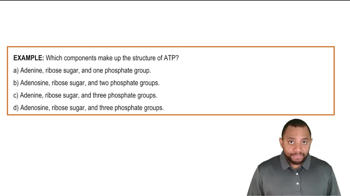
ATP (Adenosine Triphosphate)

ATP is the primary energy carrier in all living organisms. It stores energy in its high-energy phosphate bonds, which can be released to fuel various cellular processes. Understanding ATP's role is crucial for determining whether a process releases or requires energy during metabolic reactions.
Video consigliato:
Percorso guidato
1:03
Adenosine Triphosphate (ATP) Example 2

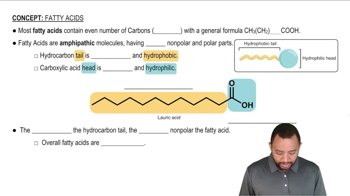
Fatty Acid Activation

Fatty acid activation is the process by which fatty acids are converted into acyl-CoA, a form that can enter metabolic pathways like beta-oxidation. This process requires energy, specifically the hydrolysis of ATP to AMP and pyrophosphate, indicating that it is an energy-consuming reaction.
Video consigliato:
Percorso guidato
2:00
Fatty Acids Concept 1

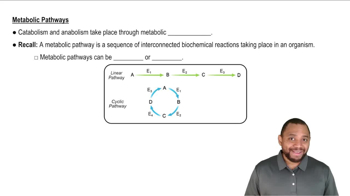
Metabolic Pathways

Metabolic pathways are sequences of chemical reactions occurring within a cell, where the product of one reaction serves as the substrate for the next. Understanding these pathways helps in identifying whether specific processes, such as fatty acid activation, are energy-requiring or energy-releasing, based on their overall energy balance.
Video consigliato:
Percorso guidato
0:52
Metabolic Pathways Concept 2