Indietro
Problema 4e
State the number of electrons lost or gained when the following elements form ions:
e. Rb
Problema 10b
Write the symbol for the ion of each of the following:
b. barium
Problema 11a
Write the names for each of the following ions:
a. Li+
Problema 11d
Write the names for each of the following ions:
d. P3-
Problema 12b
Write the names for each of the following ions:
b. Sr2+
Problema 17e
Write the correct ionic formula for the compound formed between each of the following pairs of ions:
e. Al3+ and S2-
Problema 18b
Write the correct ionic formula for the compound formed between each of the following pairs of ions:
b. Ca2+ and S2-
Problema 20c
Write the symbols for the ions, and the correct formula for the ionic compound formed by each of the following:
c. sodium and phosphorus
Problema 24e
Write the name for each of the following ions (include the Roman numeral when necessary):
e. Au3+
Problema 28a
Write the symbol for the cation in each of the following ionic compounds:
a. FeCl2
Problema 36b
Write the formula including the charge for each of the following polyatomic ions:
b. sulfite
Problema 37c
Name the following polyatomic ions:
c. HSO3-
Problema 44d
Write the formula for the polyatomic ion and name each of the following compounds:
d. Fe(HCO3)3
Problema 59d
Draw the Lewis structure for each of the following molecules:
d. ClNO2 (N is the central atom)
Problema 65
Which electronegativity difference (a, b, or c) would you expect for a nonpolar covalent bond?
a. from 0.0 to 0.4
b. from 0.5 to 1.8
c. from 1.9 to 3.3
Problema 69a
For each of the following bonds, indicate the positive end with 𝛿⁺ and the negative end with 𝛿⁻ . Draw an arrow to show the dipole for each.
a. N and F
Problema 71b
Choose the shape (1 to 6) that matches each of the following descriptions (a to c):
1. linear
2. bent (109°)
3. trigonal planar
4. bent (120°)
5. trigonal pyramidal
6. tetrahedral
b. a molecule with a central atom that has four electron groups and three bonded atoms
Problema 74c
Complete each of the following statements for a molecule of H2S:
c. The number of atoms attached to the central S atom is _______.
Problema 75
Compare the Lewis structures of CF4 and NF3 Why do these molecules have different shapes?
Problema 76
Compare the Lewis structures of CH4 and H2O Why do these molecules have similar bond angles but different molecular shapes?
Problema 80
Why is CCl4 a nonpolar molecule, but is PCl3 a polar molecule?
Problema 86b
Identify the major type of intermolecular forces between the particles of each of the following:
b. MgF2
Problema 93a
How does the octet rule explain the formation of a magnesium ion?
Problema 93b
What noble gas has the same electron arrangement as the magnesium ion?
Problema 93c
Why are Group 1A (1) and Group 2A (2) elements found in many compounds, but not Group 8A (18) elements?
Problema 97b
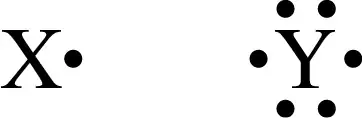
Consider the following Lewis symbols for elements X and Y:
b. Will a compound of X and Y be ionic or molecular?
Problema 97c
Consider the following Lewis symbols for elements X and Y:
c. What ions would be formed by X and Y?
Problema 97d
Consider the following Lewis symbols for elements X and Y:
d. What would be the formula of a compound of X and Y?
Problema 97e
Consider the following Lewis symbols for elements X and Y:
e. What would be the formula of a compound of X and sulfur?
Problema 97g
Consider the following Lewis symbols for elements X and Y:
g. Is the compound in part f ionic or molecular?