Ch. 9 - Biotechnology & DNA Technology
Tortora - Microbiology: An Introduction 14th Edition
Tortora14th EditionMicrobiology: An IntroductionISBN: 9780138200398Non è quello che usi tu?Cambia libro di testo
Capitolo 5, Problema 6

Describe an rDNA experiment in two or three sentences. Use the following terms: intron, exon, DNA, mRNA, cDNA, RNA polymerase, reverse transcriptase.

Guida verificata passo dopo passo
1
Begin by explaining that DNA contains both exons (coding regions) and introns (non-coding regions), and RNA polymerase transcribes DNA into pre-mRNA, which includes both exons and introns.
Next, describe how the pre-mRNA undergoes splicing to remove introns, resulting in mature mRNA that contains only exons.
Then, explain that reverse transcriptase is used to synthesize complementary DNA (cDNA) from the mature mRNA, which can be used in recombinant DNA (rDNA) experiments to study or manipulate specific gene sequences without introns.

Risposta video verificata per un problema simile:

Questa soluzione video è stata consigliata dai nostri tutor come utile per risolvere questo problema.
Durata del video:
1m

Concetti chiave

Ecco i concetti essenziali che devi comprendere per rispondere correttamente alla domanda.

Gene Structure: Introns and Exons

Genes are composed of exons, which code for proteins, and introns, non-coding sequences removed during mRNA processing. Understanding this distinction is crucial for interpreting how mRNA and cDNA represent only the exon sequences of a gene.
Video consigliato:
05:30
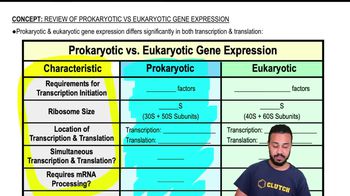
Review of Prokaryotic vs. Eukaryotic Gene Expression

Transcription and RNA Polymerase

RNA polymerase synthesizes mRNA from a DNA template by transcribing only the exons and introns present in the gene. This process produces a primary mRNA transcript that undergoes splicing to remove introns before translation.
Video consigliato:
05:03
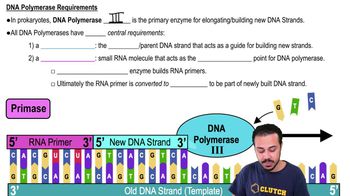
DNA Polymerases Requirements

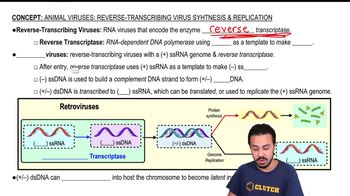
Reverse Transcriptase and cDNA Synthesis

Reverse transcriptase is an enzyme that converts processed mRNA back into complementary DNA (cDNA), which lacks introns. This cDNA can be used in recombinant DNA experiments to clone genes without introns, facilitating gene expression studies.
Video consigliato:
04:28
Animal Viruses: Reverse-Transcribing Virus Synthesis & Replication