Indietro
Problema 15a
What hydrocarbon with molecular formula C4H10 forms only two monochlorinated products? Both products are achiral.
Problema 15b
What hydrocarbon with the same molecular formula as in part a forms three monochlorinated products? One is achiral and two are chiral.
Problema 18a
Two products are formed when methylenecyclohexane reacts with NBS? Show how each is formed. Disregard stereoisomers.
Problema 19
How many allylic substituted bromoalkenes are formed from the reactions in Problems 17 if stereoisomers are included?
Problema 19a
How many allylic substituted bromoalkenes are formed from the reactions in Problems 18 if stereoisomers are included?
Problema 20a
How many stereoisomers are formed from the reaction of cyclohexene with NBS?
Problema 20b
How many stereoisomers are formed from the reaction of 3-methylcyclohexene with NBS?
Problema 21a
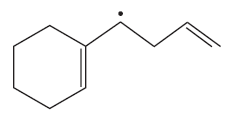
Draw the resonance contributors for the following radicals:
a.
Problema 21c
Draw the resonance contributors for the following radicals:
c.
Problema 21d
Draw the resonance contributors for the following radicals:
d.
Problema 22a(1,2)
Draw the major product(s) of the reaction of 1-methylcyclohexene with the following reagents, disregarding stereoisomers:
1. NBS/∆/peroxide
2. Br2/CH2Cl2
Problema 22a(3,4)
Draw the major product(s) of the reaction of 1-methylcyclohexene with the following reagents, disregarding stereoisomers:
3. HBr
4. HBr/peroxide
Problema 22b(1,2)
For each reaction, show which stereoisomers are obtained
1. NBS/∆/peroxide
2. Br2/CH2Cl2
Problema 23a
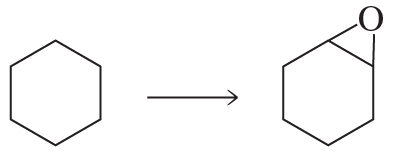
Design a multistep synthesis to show how the following compounds can be prepared from the given starting material:
a.
Problema 23d
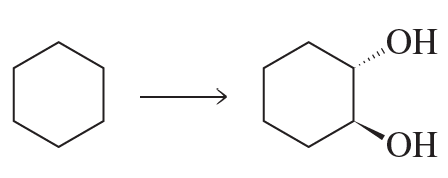
Design a multistep synthesis to show how the following compounds can be prepared from the given starting material:
d.
Problema 24
How many atoms share the unpaired electron in semiquinone?

Problema 26c
What are the product(s) of each of the following reactions? Disregard stereoisomers.
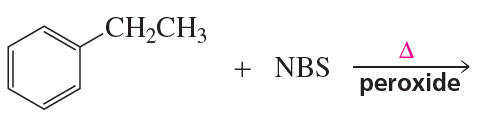
c.
Problema 26d
What are the product(s) of each of the following reactions? Disregard stereoisomers.
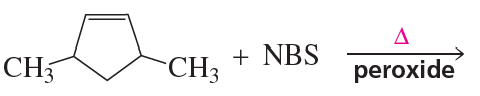
d.
Problema 26e
What are the product(s) of each of the following reactions? Disregard stereoisomers.
e.
Problema 26f
What are the product(s) of each of the following reactions? Disregard stereoisomers.
f.
Problema 27a
What alkane, with molecular formula C5H12, forms only one monochlorinated product when it is heated with Cl2?
Problema 28
Explain why iodine (I2) does not react with ethane, even though I2 is more easily cleaved homolytically than the other halogens.
Problema 29a
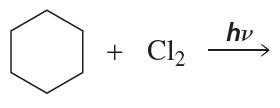
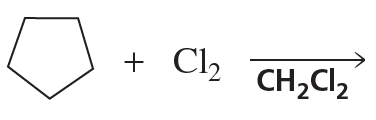
What is the major product obtained from treating an excess of each of the following compounds with Cl2 in the presence of ultraviolet light at room temperature? Disregard stereoisomers.
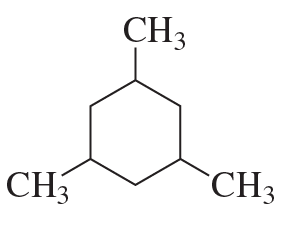
a.
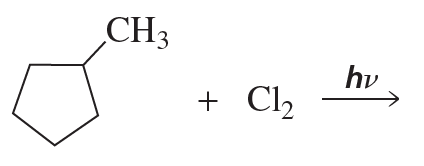
Problema 29c
What is the major product obtained from treating an excess of each of the following compounds with Cl2 in the presence of ultraviolet light at room temperature? Disregard stereoisomers.
c.
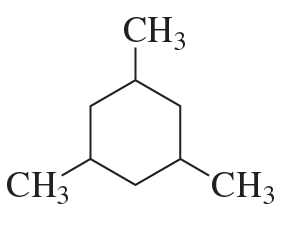
Problema 30c
What are the answers to Problem 29 when the same compounds are treated with Br2 at 125 °C?
c.
Problema 31a
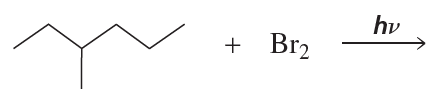
What is the major product of the following reactions? Disregard stereoisomers:
a.
Problema 31b
What is the major product of the following reactions? Disregard stereoisomers:
b.
Problema 31c
What is the major product of the following reactions? Disregard stereoisomers:
c.
Problema 31d
What is the major product of the following reactions? Disregard stereoisomers:
d.
Problema 32
When 2-methylpropane is monochlorinated in the presence of light at room temperature, 36% of the product is 2-chloro-2-methylpropane and 64% is 1-chloro-2-methylpropane. From these data, calculate how much easier it is to remove a hydrogen atom from a tertiary carbon than from a primary carbon under these conditions.