Indietro
Problema 1
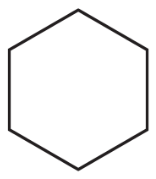
Write the initiation, propagation, and termination steps for the monochlorination of cyclohexane.
Problema 2
Write the steps for formation of tetrachloromethane (CCl4) from the reaction of methane with Cl2 + hv.
Problema 3
a. Which of the hydrogens in the structure in the margin is the easiest for a chlorine radical to remove?
b. How many secondary hydrogens does the structure have?
Problema 4a
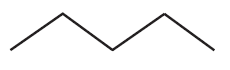
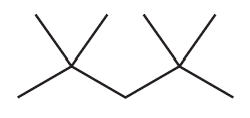
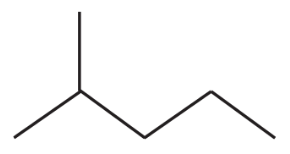
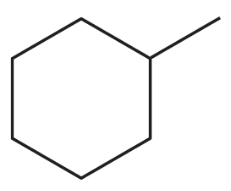
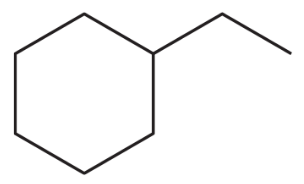
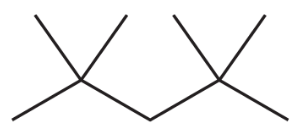
How many alkyl chlorides are obtained from monochlorination of the following alkanes? Disregard stereoisomers.
a.
Problema 4b
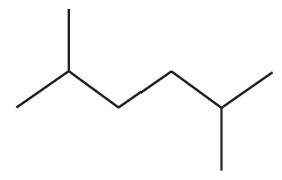
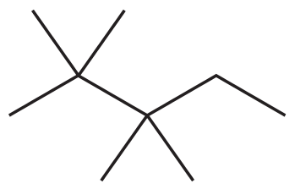
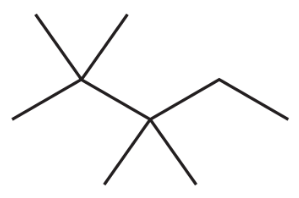
How many alkyl chlorides are obtained from monochlorination of the following alkanes? Disregard stereoisomers.
b.
Problema 4e
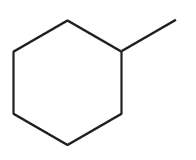
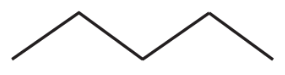
How many alkyl chlorides are obtained from monochlorination of the following alkanes? Disregard stereoisomers.
e.
Problema 4f
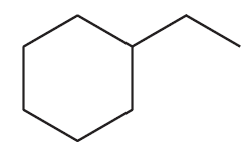
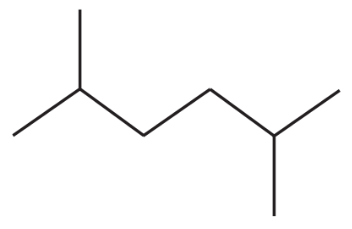
How many alkyl chlorides are obtained from monochlorination of the following alkanes? Disregard stereoisomers.
f.
Problema 4g
How many alkyl chlorides are obtained from monochlorination of the following alkanes? Disregard stereoisomers.
g.
Problema 4h
How many alkyl chlorides are obtained from monochlorination of the following alkanes? Disregard stereoisomers.
h.
Problema 5
If cyclopentane reacts with more than one equivalent of Cl2 at a high temperature, how many dichlorocyclopentanes would you expect to obtain as products?
Problema 6a
How many alkyl halides are obtained from monochlorination of the alkanes in Problem 4 if stereoisomers are included?
a.
Problema 6b
How many alkyl halides are obtained from monochlorination of the alkanes in Problem 4 if stereoisomers are included?
b.
Problema 6c
How many alkyl halides are obtained from monochlorination of the alkanes in Problem 4 if stereoisomers are included?
c.
Problema 6d
How many alkyl halides are obtained from monochlorination of the alkanes in Problem 4 if stereoisomers are included?
d.
Problema 6e
How many alkyl halides are obtained from monochlorination of the alkanes in Problem 4 if stereoisomers are included?
e.
Problema 6f
How many alkyl halides are obtained from monochlorination of the alkanes in Problem 4 if stereoisomers are included?
f.
Problema 6g
How many alkyl halides are obtained from monochlorination of the alkanes in Problem 4 if stereoisomers are included?
g.
Problema 6h
How many alkyl halides are obtained from monochlorination of the alkanes in Problem 4 if stereoisomers are included?
h.
Problema 8a
What is the major product of the reaction in Problem 7 when the alkane reacts with Cl2 instead of with Br2? Disregard stereoisomers.
Problema 8b
What is the anticipated percent yield of the major product?
Problema 9a
Would chlorination or bromination produce a greater yield of 1-halo-2,3-dimethylbutane?
Problema 9b
Would chlorination or bromination produce a greater yield of 2-halo-2,3-dimethylbutane?
Problema 9c
Would chlorination or bromination be a better way to make 1-halo-2,2-dimethylpropane?
Problema 11a
Show how the following compounds could be prepared from 2-methylpropane:
a. 2-bromo-2-methylpropane
Problema 11b
Show how the following compounds could be prepared from 2-methylpropane:
b. 2-methyl-1-propene
Problema 11c
Show how the following compounds could be prepared from 2-methylpropane:
c. 2-iodo-2-methylpropane
Problema 12a
Which ether is most apt to form a peroxide?
Problema 12b
Which ether is least apt to form a peroxide?
Problema 13
Write the propagation steps for the addition of HBr to 1-methylcyclohexene in the presence of a peroxide
Problema 14c,d
What is the major product of the reaction of 2-methyl-2-butene with each of the following reagents?
c. HBr + peroxide
d. HCl + peroxide