Ch. 12 - Radicals
Bruice - Organic Chemistry 8th Edition
Bruice8th EditionOrganic ChemistryISBN: 9780135213711Non è quello che usi tu?Cambia libro di testo
Capitolo 12, Problema 32

When 2-methylpropane is monochlorinated in the presence of light at room temperature, 36% of the product is 2-chloro-2-methylpropane and 64% is 1-chloro-2-methylpropane. From these data, calculate how much easier it is to remove a hydrogen atom from a tertiary carbon than from a primary carbon under these conditions.

Guida verificata passo dopo passo
1
Identify the type of hydrogens in 2-methylpropane. The molecule has two types of hydrogens: primary hydrogens (attached to primary carbons) and tertiary hydrogens (attached to the tertiary carbon).
Determine the number of each type of hydrogen in 2-methylpropane. There are 9 primary hydrogens (3 on each of the three methyl groups) and 1 tertiary hydrogen (on the central carbon).
Use the product distribution data to relate the reactivity of each type of hydrogen. The product distribution indicates that 36% of the product is 2-chloro-2-methylpropane (from tertiary hydrogen abstraction) and 64% is 1-chloro-2-methylpropane (from primary hydrogen abstraction).
Set up a ratio to compare the relative reactivity of tertiary hydrogens to primary hydrogens. The relative reactivity is proportional to the product distribution divided by the number of hydrogens of each type. For tertiary hydrogens: \( \text{Reactivity}_{\text{tertiary}} = \frac{36}{1} \), and for primary hydrogens: \( \text{Reactivity}_{\text{primary}} = \frac{64}{9} \).
Calculate the ratio of \( \text{Reactivity}_{\text{tertiary}} \) to \( \text{Reactivity}_{\text{primary}} \) to determine how much easier it is to remove a hydrogen atom from a tertiary carbon compared to a primary carbon. This ratio will give the relative ease of abstraction under the given conditions.

Risposta video verificata per un problema simile:

Questa soluzione video è stata consigliata dai nostri tutor come utile per risolvere questo problema.
Durata del video:
5m

Concetti chiave

Ecco i concetti essenziali che devi comprendere per rispondere correttamente alla domanda.

Radical Halogenation

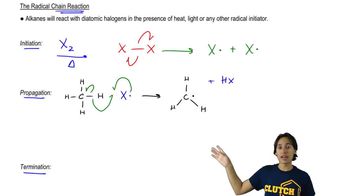
Radical halogenation is a reaction where alkanes react with halogens in the presence of light or heat to form alkyl halides. This process involves the formation of free radicals, which are highly reactive species with unpaired electrons. The reaction typically proceeds through three steps: initiation, propagation, and termination. Understanding this mechanism is crucial for analyzing the distribution of products formed during chlorination.
Video consigliato:
12:11
Radical Chain Reaction Mechanism.

Tertiary vs. Primary Carbons

In organic chemistry, carbons are classified based on the number of other carbon atoms they are bonded to. A tertiary carbon is bonded to three other carbons, while a primary carbon is bonded to only one. The stability of radicals formed from these carbons differs significantly; tertiary radicals are more stable due to hyperconjugation and inductive effects, making it easier to abstract a hydrogen atom from tertiary carbons compared to primary ones.
Video consigliato:
Percorso guidato
2:07
Tertiary Protein Structure Concept 1

Product Distribution and Reactivity

The distribution of products in a reaction can provide insights into the relative reactivity of different types of hydrogen atoms. In the case of chlorination, the ratio of 2-chloro-2-methylpropane to 1-chloro-2-methylpropane indicates that hydrogen atoms from tertiary carbons are removed more readily than those from primary carbons. This product distribution can be quantitatively analyzed to determine the relative ease of hydrogen abstraction, which is essential for understanding the selectivity of the reaction.
Video consigliato:
11:07
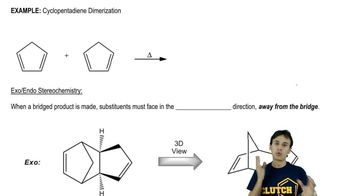
Bridged-Products