Ch. 12 - Radicals
Bruice - Organic Chemistry 8th Edition
Bruice8th EditionOrganic ChemistryISBN: 9780135213711Non è quello che usi tu?Cambia libro di testo
Capitolo 12, Problema 20b

How many stereoisomers are formed from the reaction of 3-methylcyclohexene with NBS?

Guida verificata passo dopo passo
1
Identify the type of reaction: The reaction of 3-methylcyclohexene with NBS (N-bromosuccinimide) is an allylic bromination reaction. NBS selectively brominates the allylic position of alkenes in the presence of light or a radical initiator.
Determine the allylic positions: In 3-methylcyclohexene, the allylic positions are the carbon atoms adjacent to the double bond. These positions are susceptible to bromination.
Analyze the stereochemistry: Bromination at the allylic position can generate chiral centers depending on the structure of the molecule. Consider the possible configurations (R and S) at each chiral center formed during the reaction.
Account for symmetry: Examine the symmetry of the molecule to determine if any of the stereoisomers are identical or enantiomers. This will help in counting the unique stereoisomers.
Calculate the total number of stereoisomers: Use the formula for stereoisomers, which is 2^n, where n is the number of chiral centers. Adjust for any symmetry or meso compounds to determine the final count of stereoisomers.

Risposta video verificata per un problema simile:

Questa soluzione video è stata consigliata dai nostri tutor come utile per risolvere questo problema.
Durata del video:
7m

Concetti chiave

Ecco i concetti essenziali che devi comprendere per rispondere correttamente alla domanda.

Stereoisomerism

Stereoisomerism refers to the phenomenon where compounds have the same molecular formula and connectivity of atoms but differ in the spatial arrangement of those atoms. This can lead to different physical and chemical properties. In organic chemistry, stereoisomers can be classified into enantiomers and diastereomers, which are crucial for understanding the behavior of molecules in reactions.
Video consigliato:
01:58
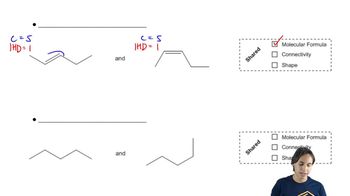
Determining when molecules are stereoisomers.

NBS (N-Bromosuccinimide)

N-Bromosuccinimide (NBS) is a reagent commonly used in organic synthesis for bromination reactions, particularly in allylic and benzylic positions. It provides a source of bromine in a controlled manner, allowing for the formation of brominated products without excessive side reactions. Understanding how NBS reacts with alkenes is essential for predicting the stereochemical outcomes of reactions.
Video consigliato:
Percorso guidato
3:06
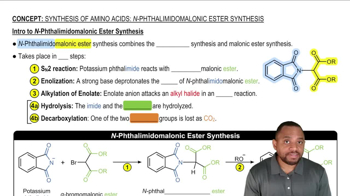
Synthesis of Amino Acids: N-Phthalimidomalonic Ester Synthesis Concept 1

Cycloalkene Reactivity

Cycloalkenes, such as 3-methylcyclohexene, exhibit unique reactivity due to their cyclic structure and the presence of double bonds. The reaction of cycloalkenes with electrophiles like NBS can lead to the formation of various products, including brominated stereoisomers. Analyzing the stereochemical implications of these reactions is vital for determining the number of possible stereoisomers formed.
Video consigliato:
01:11
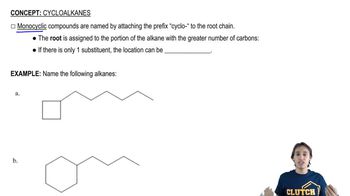
How to find the root name for cycloalkanes