Indietro
 Mullins 1st EditionCh. 10 - Alkynes: Electrophilic Addition and Redox Reactions
Problema 40d
When doing synthesis, you will often find yourself repeating the same series of steps. To see this in action, synthesize the following aldehydes beginning with an organic molecule containing three carbons or fewer.
(d)
Problema 41a
Beginning with the molecules on the left of each chemical equation, synthesize the molecules shown. While there can be multiple ways of doing each synthesis, the minimum number of steps necessary is indicated over each reaction arrow.
(a)
Problema 41b
Beginning with the molecules on the left of each chemical equation, synthesize the molecules shown. While there can be multiple ways of doing each synthesis, the minimum number of steps necessary is indicated over each reaction arrow.
(b)
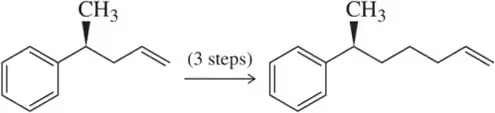
Problema 41c
Beginning with the molecules on the left of each chemical equation, synthesize the molecules shown. While there can be multiple ways of doing each synthesis, the minimum number of steps necessary is indicated over each reaction arrow.
(c)
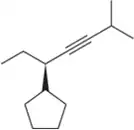
Problema 42b
Name the following alkynes according to the IUPAC rules of nomenclature.
(b)
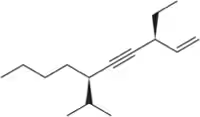
Problema 42c
Name the following alkynes according to the IUPAC rules of nomenclature.
(c)
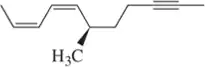
Problema 42d
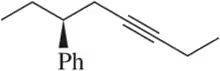
Name the following alkynes according to the IUPAC rules of nomenclature.
(d)
Problema 43a
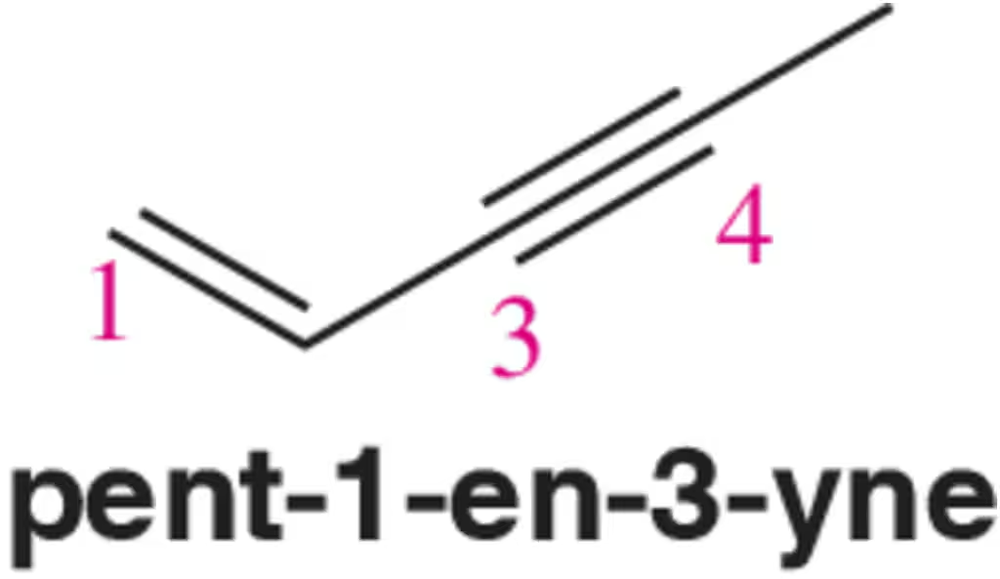
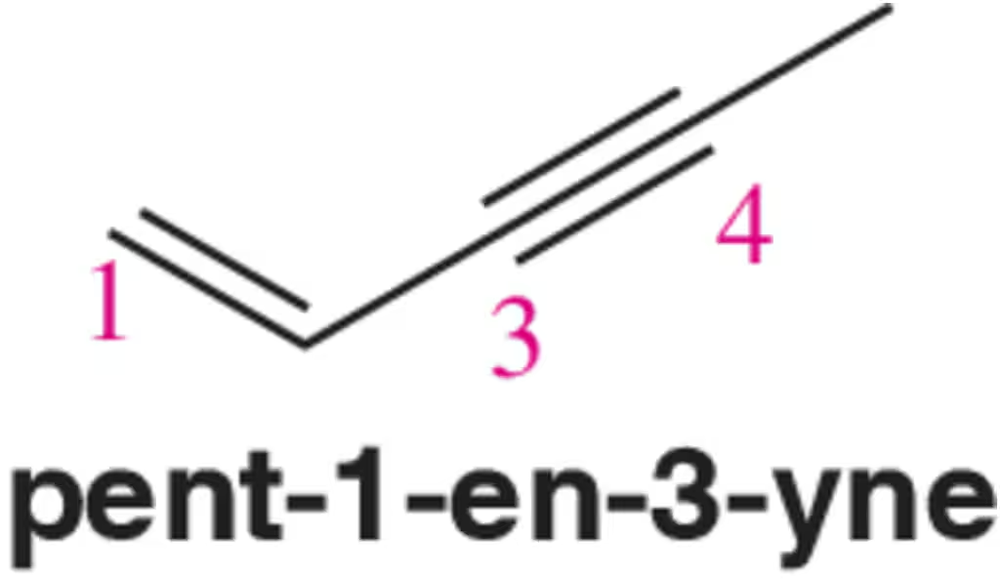
Draw the molecular orbital picture of pent-1-en-3-yne.
Problema 43b
To which carbon would you expect an electrophile to add (1, 3, or 4)? Explain your answer.
Problema 44c(i)
For the alkynes shows here, show the product(s) expected to form when treated under the following conditions: (i) H2 , Pd/C; If you expect two products, show both.
(c)
Problema 44c(viii)
For the alkynes shows here, show the product(s) expected to form when treated under the following conditions: (viii) Cl2 (1 equiv.). If you expect two products, show both.
(c)
Problema 44c(iii)
For the alkynes shows here, show the product(s) expected to form when treated under the following conditions: (iii) Na0 , NH3 (liquid), ―33°C . If you expect two products, show both.
(c)
Problema 44c(ix)
For the alkynes shows here, show the product(s) expected to form when treated under the following conditions: (ix) Br2 (2 equiv.). If you expect two products, show both.
(c)
Problema 44c(vi)
For the alkynes shows here, show the product(s) expected to form when treated under the following conditions: (vi) H2SO4, HgSO4, H2O. If you expect two products, show both.
(c)
Problema 44c(iv)
For the alkynes shows here, show the product(s) expected to form when treated under the following conditions: (iv) HBr (1 equiv.). If you expect two products, show both.
(c)
Problema 44c(v)
For the alkynes shows here, show the product(s) expected to form when treated under the following conditions: (v) HCl (2 equiv.). If you expect two products, show both.
(c)
Problema 44c(ii)
For the alkynes shows here, show the product(s) expected to form when treated under the following conditions: (ii) H2, Pd/C, Pb(OAc)2 , CaCO3 (Lindlar's catalyst). If you expect two products, show both.
(c)
Problema 44c(vii)
For the alkynes shows here, show the product(s) expected to form when treated under the following conditions: (vii) 1. BH3 2. H2O2, NaOH. If you expect two products, show both.
(c)
Problema 44f(ix)
For the alkynes shows here, show the product(s) expected to form when treated under the following conditions: (ix) Br2 (2 equiv.). If you expect two products, show both.
(f)
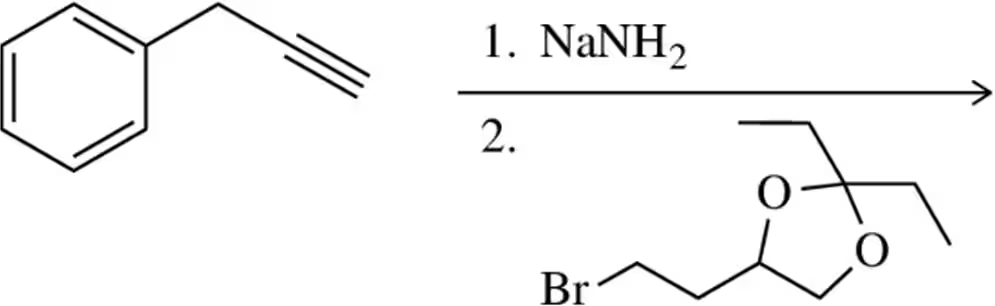
Problema 45a
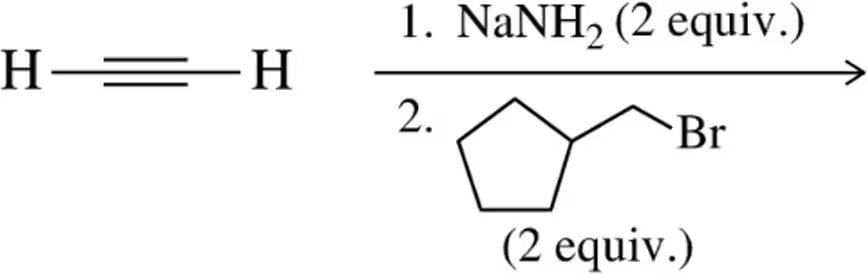
Show the products of the following acetylide alkylation reactions. [Make sure your product has the correct number of carbons.]
(a)
Problema 45b
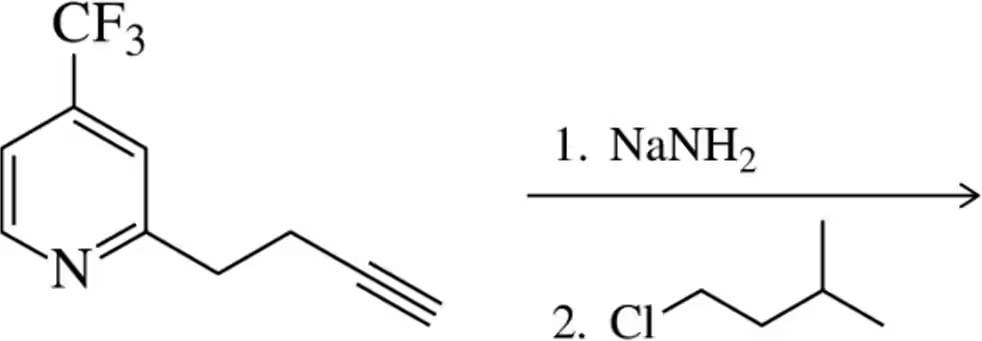
Show the products of the following acetylide alkylation reactions. [Make sure your product has the correct number of carbons.]
(b)
Problema 45c
Show the products of the following acetylide alkylation reactions. [Make sure your product has the correct number of carbons.]
(c)
Problema 45d
Show the products of the following acetylide alkylation reactions. [Make sure your product has the correct number of carbons.]
(d)
Problema 46
Complete the following synthesis by providing the necessary reagents.
Problema 47a
Suggest a method for synthesizing the following alkynes using an alkyne and an alkyl halide. [There are two correct answers for each product.]
(a)
Problema 47c
Suggest a method for synthesizing the following alkynes using an alkyne and an alkyl halide. [There are two correct answers for each product.]
(c)
Problema 48a
Beginning with the molecules on the left, provide a synthesis of the molecule on the right. The ideal number of steps is indicated over the reaction arrow, although there may be alternate routes worth considering.
(a)
Problema 48b
Beginning with the molecules on the left, provide a synthesis of the molecule on the right. The ideal number of steps is indicated over the reaction arrow, although there may be alternate routes worth considering.
(b)
Problema 49b
Synthesize the following molecules beginning with only organic molecules containing three carbons or fewer.
(b)
Problema 49e
Synthesize the following molecules beginning with only organic molecules containing three carbons or fewer.
(e)