Indietro
 Mullins 1st EditionCh. 19 - Nucleophilic Acyl Substitution 2: Carboxylic Acid Derivatives
Problema 1
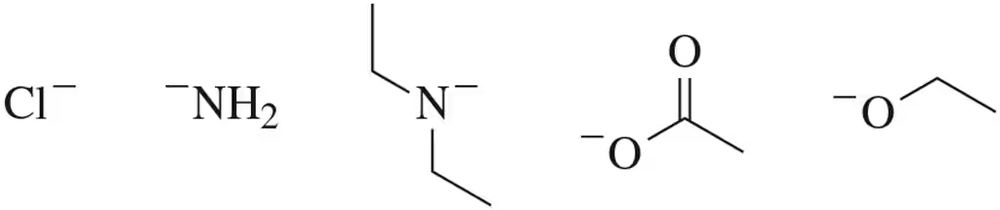
Rank the following anions based on their stability as potential leaving groups. Explain your reasoning (1 = most stable ; 5 = least stable).
Problema 2
Would you expect a ketone or an ester to be more reactive with a strong nucleophile? Justify your answer.
Problema 7a
Which of the following are considered carboxylic acid derivatives?
(a)
Problema 9d
Provide the IUPAC name for the following molecules.
(d)
Problema 9e
Provide the IUPAC name for the following molecules.
(e)
Problema 10a
Provide a molecular structure that corresponds to the given name.
(a) benzoic propanoic anhydride
Problema 10e
Provide a molecular structure that corresponds to the given name.
(e) (R)-N,N-diethyl 5-cyclohexyl-3-methoxypentanamide
Problema 11b
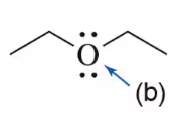
Predict the hybridization of the indicated atoms.
(b)
Problema 14
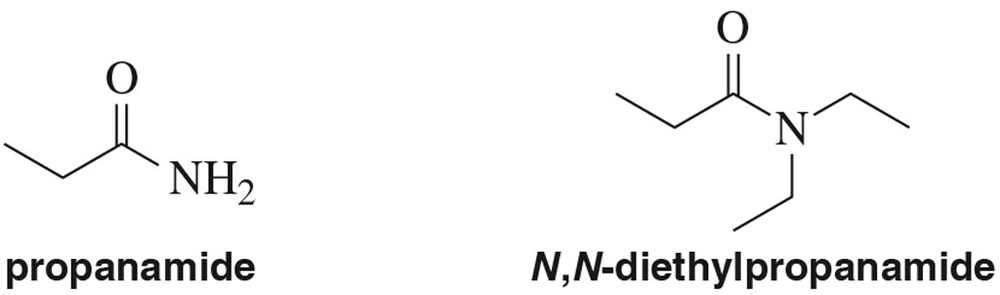
How would you expect the IR and ¹H NMR spectra for propanamide and N,N-diethylpropanamide to differ?
Problema 15
You might expect that aldehydes and ketones could undergo the addition/elimination mechanism. With strong nucleophiles, however, nucleophilic addition is the only outcome. Why?
Problema 24
A chemist unsuccessfully attempted to produce the 1,4-cyclohexanediol by hydration of the cyclohexene shown.
(a) Provide a mechanism for the formation of the actual product.
(b) Suggest a pathway using acetyl chloride as a protecting group that will allow for the formation of the desired product.
Problema 36a
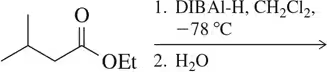
Predict the product of the following reductions.
(a)
Problema 36b
Predict the product of the following reductions.
(b)
Problema 36c
Predict the product of the following reductions.
(c)
Problema 36d
Predict the product of the following reductions.
(d)
Problema 37
Show a mechanism for the lithium aluminum hydride reduction of benzoic anhydride.
Problema 38
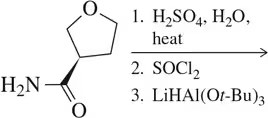
Predict the product of the multistep synthesis reaction shown.
Problema 39a
Predict the product of the following reaction sequences.
(a)
Problema 39b
Predict the product of the following reaction sequences.
(b)
Problema 39c
Predict the product of the following reaction sequences.
(c)
Problema 40a
The esters shown differ only by the alkoxy group.
(i) Predict the product(s) obtained when these react with DIBAl-H.
(ii) Based on your answer, in a sequence like this, would there ever be a need to convert from one ester to another?
(a)
Problema 40b
The esters shown differ only by the alkoxy group.
(i) Predict the product(s) obtained when these react with DIBAl-H.
(ii) Based on your answer, in a sequence like this, would there ever be a need to convert from one ester to another?
(b)
Problema 41
When the ester attacked the aluminum of DIBAl-H, why did the carbonyl oxygen attack preferentially over the alkoxy oxygen?
Problema 46
Why is a ketone more reactive/electrophilic than an ester?
Problema 47a
Predict the product of the following reactions.
(a)
Problema 47b
Predict the product of the following reactions.
(b)
Problema 47c
Predict the product of the following reactions.
(c)
Problema 48a
Suggest a series of steps involving a cuprate reagent that would convert the reactant on the left to the product on the right. The ideal number of steps is shown.
(a)
Problema 48b
Suggest a series of steps involving a cuprate reagent that would convert the reactant on the left to the product on the right. The ideal number of steps is shown.
(b)
Problema 48c
Suggest a series of steps involving a cuprate reagent that would convert the reactant on the left to the product on the right. The ideal number of steps is shown.
(c)