Ch. 24 - Benzene 2: Reactions Influenced by the Aromatic Ring
Mullins - Organic Chemistry: A Learner Centered Approach 1st Edition
Mullins1st EditionOrganic Chemistry: A Learner Centered ApproachISBN: 9780137566471Non è quello che usi tu?Cambia libro di testo
Capitolo 23, Problema 43

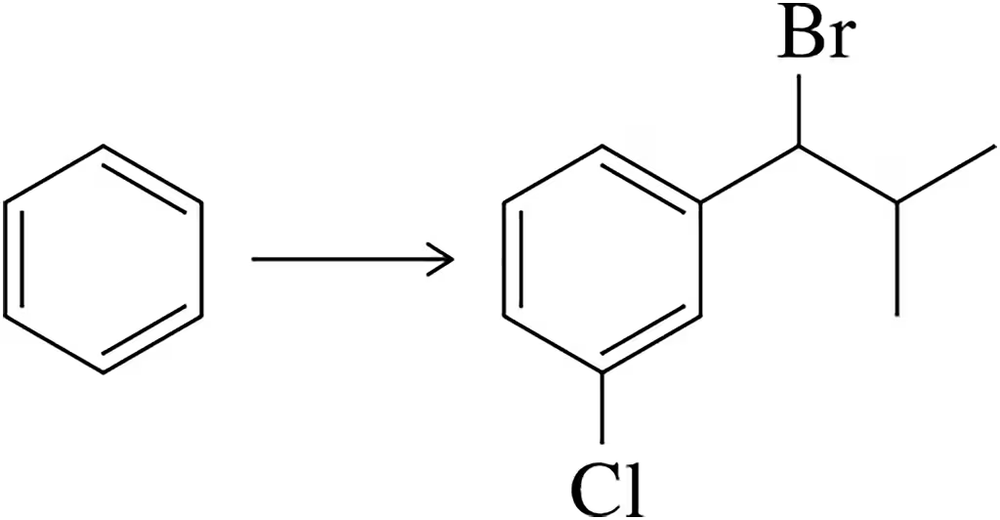
Beginning with benzene, synthesize the benzyl bromide shown.
Benzene structure transforming into benzyl bromide with a chlorine substituent, illustrating a chemical synthesis process.

Guida verificata passo dopo passo
1
Start with benzene and perform a Friedel-Crafts alkylation using isopropyl chloride (CH3CHClCH3) and AlCl3 as a catalyst to introduce the isopropyl group onto the benzene ring, forming isopropylbenzene.
Next, perform a chlorination reaction on isopropylbenzene using Cl2 and FeCl3 to introduce a chlorine atom at the para position relative to the isopropyl group, forming para-chloroisopropylbenzene.
To introduce the bromine atom, perform a free radical bromination on the benzylic position of para-chloroisopropylbenzene using N-bromosuccinimide (NBS) and light (hv) to form para-chloro-1-bromo-2-isopropylbenzene.
Ensure that the reaction conditions are controlled to favor substitution at the benzylic position rather than the aromatic ring.
Finally, verify the structure of the synthesized compound to ensure it matches the target molecule, which is para-chloro-1-bromo-2-isopropylbenzene.

Risposta video verificata per un problema simile:

Questa soluzione video è stata consigliata dai nostri tutor come utile per risolvere questo problema.
Durata del video:
5m

Concetti chiave

Ecco i concetti essenziali che devi comprendere per rispondere correttamente alla domanda.

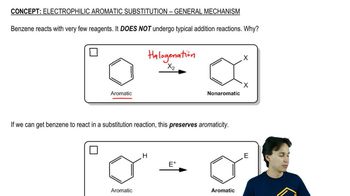
Electrophilic Aromatic Substitution

Electrophilic aromatic substitution (EAS) is a fundamental reaction in organic chemistry where an electrophile replaces a hydrogen atom on an aromatic ring, such as benzene. This reaction is crucial for synthesizing various derivatives of benzene, including benzyl bromide. Understanding the mechanisms of EAS, including the formation of the sigma complex and the role of catalysts, is essential for predicting the outcomes of reactions involving aromatic compounds.
Video consigliato:
03:07
EAS Review

Bromination of Aromatic Compounds

Bromination is a specific type of electrophilic aromatic substitution where bromine acts as the electrophile. In the synthesis of benzyl bromide, bromine can be introduced to the benzene ring through the use of bromine (Br2) in the presence of a Lewis acid catalyst, such as FeBr3. This process highlights the importance of understanding how to generate and stabilize the electrophile for successful substitution reactions.
Video consigliato:
00:54
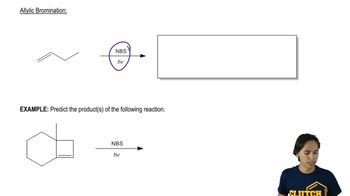
Mechanism of Allylic Bromination.

Nucleophilic Substitution Reactions

Nucleophilic substitution reactions involve the replacement of a leaving group by a nucleophile. In the context of synthesizing benzyl bromide, once the benzene ring is functionalized to form benzyl bromide, a nucleophilic substitution can occur where a bromide ion (Br-) replaces a hydrogen atom. Familiarity with the mechanisms of both SN1 and SN2 reactions is vital for understanding how to manipulate the reactivity of the benzyl group in further synthetic steps.
Video consigliato:
01:47
Nucleophiles and Electrophiles can react in Substitution Reactions.