Ch. 24 - Benzene 2: Reactions Influenced by the Aromatic Ring
Mullins - Organic Chemistry: A Learner Centered Approach 1st Edition
Mullins1st EditionOrganic Chemistry: A Learner Centered ApproachISBN: 9780137566471Non è quello che usi tu?Cambia libro di testo
Capitolo 23, Problema 40

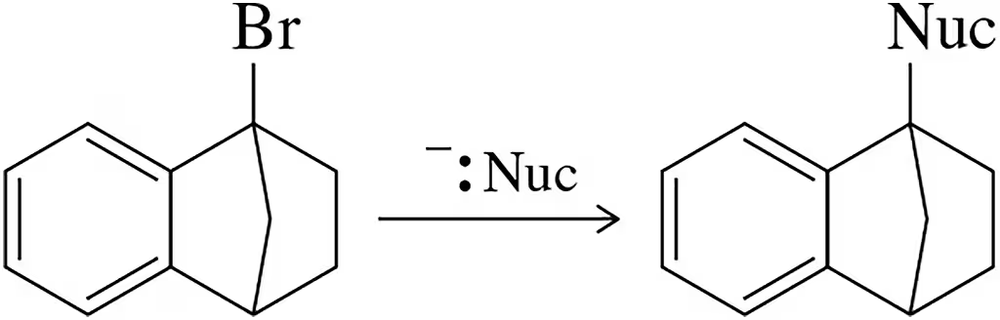
The benzylic bromide shown undergoes neither SN1 nor SN2 substitution reactions. Explain.

Guida verificata passo dopo passo
1
Identify the structure of the benzylic bromide. A benzylic bromide has a bromine atom attached to a carbon that is directly bonded to a benzene ring. This position is known as the benzylic position.
Analyze why the SN1 mechanism does not occur. The SN1 reaction involves the formation of a carbocation intermediate. In this case, the benzylic carbocation would be highly unstable if the benzene ring is substituted with electron-withdrawing groups, which destabilize the positive charge.
Analyze why the SN2 mechanism does not occur. The SN2 reaction requires a backside attack by the nucleophile. If the benzylic carbon is sterically hindered (e.g., due to bulky substituents on the benzene ring or the benzylic carbon), the nucleophile cannot approach effectively, preventing the reaction.
Consider the electronic effects of the benzene ring. If the benzene ring has substituents that withdraw electron density (e.g., nitro groups), they can reduce the reactivity of the benzylic carbon toward both SN1 and SN2 mechanisms.
Conclude that the lack of reactivity in both SN1 and SN2 mechanisms is due to a combination of steric hindrance and electronic effects, which make the benzylic bromide unreactive under typical substitution conditions.

Risposta video verificata per un problema simile:

Questa soluzione video è stata consigliata dai nostri tutor come utile per risolvere questo problema.
Durata del video:
5m

Concetti chiave

Ecco i concetti essenziali che devi comprendere per rispondere correttamente alla domanda.

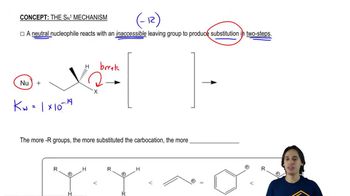
SN1 and SN2 Mechanisms

SN1 (unimolecular nucleophilic substitution) and SN2 (bimolecular nucleophilic substitution) are two fundamental mechanisms of nucleophilic substitution reactions. SN1 involves the formation of a carbocation intermediate and is favored in polar protic solvents, while SN2 involves a direct attack by the nucleophile and is favored in polar aprotic solvents. The structure of the substrate significantly influences which mechanism predominates.
Video consigliato:
10:49
Drawing the SN1 Mechanism

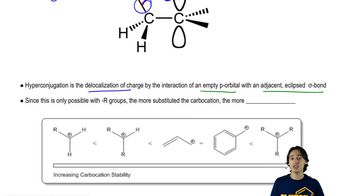
Carbocation Stability

Carbocation stability is crucial in determining the feasibility of SN1 reactions. Benzylic carbocations, which are stabilized by resonance with the aromatic ring, are generally stable. However, if the benzylic bromide does not form a stable carbocation due to steric hindrance or other factors, the SN1 pathway may be unfavorable, preventing the reaction from occurring.
Video consigliato:
05:58
Determining Carbocation Stability

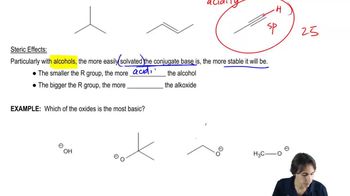
Steric Hindrance

Steric hindrance refers to the prevention of reactions due to the spatial arrangement of atoms within a molecule. In the case of SN2 reactions, bulky groups around the reactive center can hinder the nucleophile's approach, making the reaction less likely. If the benzylic bromide has significant steric hindrance, it may not undergo SN2 substitution, contributing to the lack of reactivity in both SN1 and SN2 pathways.
Video consigliato:
02:53
Understanding steric effects.