Ch. 24 - Benzene 2: Reactions Influenced by the Aromatic Ring
Mullins - Organic Chemistry: A Learner Centered Approach 1st Edition
Mullins1st EditionOrganic Chemistry: A Learner Centered ApproachISBN: 9780137566471Non è quello che usi tu?Cambia libro di testo
Capitolo 23, Problema 46

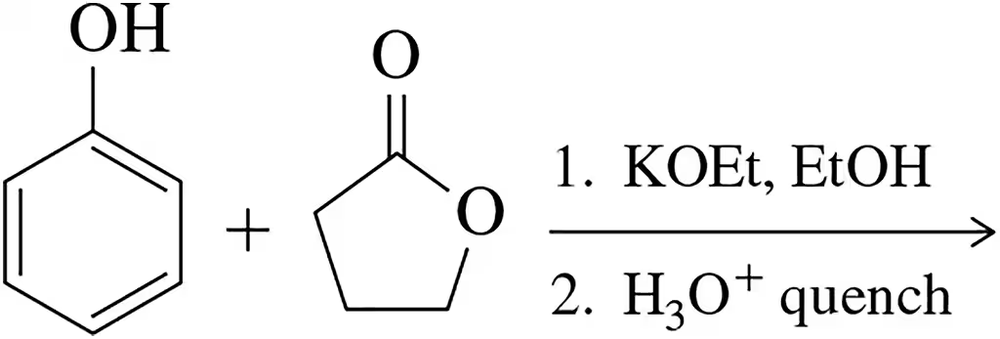
The following reaction proceeds in good yield, despite requiring high temperature and high concentration. Identify the product you’d expect to obtain in this reaction.

Guida verificata passo dopo passo
1
Identify the reactants: The reaction involves phenol (C6H5OH) and gamma-butyrolactone (a cyclic ester).
Recognize the reaction type: This is similar to the Kolbe-Schmitt reaction, where phenol reacts with carbon dioxide in the presence of a base to form salicylic acid. Here, the base is potassium ethoxide (KOEt) in ethanol.
Understand the mechanism: The phenol will be deprotonated by the strong base (KOEt) to form phenoxide ion, which is a strong nucleophile.
Nucleophilic attack: The phenoxide ion will attack the carbonyl carbon of the gamma-butyrolactone, opening the lactone ring and forming a carboxylate intermediate.
Acidic quench: The reaction mixture is then quenched with an acid (H3O+), which will protonate the carboxylate to form the final carboxylic acid product.

Risposta video verificata per un problema simile:

Questa soluzione video è stata consigliata dai nostri tutor come utile per risolvere questo problema.

Concetti chiave

Ecco i concetti essenziali che devi comprendere per rispondere correttamente alla domanda.

Nucleophilic Acyl Substitution

Nucleophilic acyl substitution is a fundamental reaction in organic chemistry where a nucleophile attacks a carbonyl carbon, leading to the substitution of a leaving group. In this case, the phenol (with -OH) acts as a nucleophile, attacking the carbonyl carbon of the cyclic anhydride. This reaction is crucial for forming esters or amides from carboxylic acids or their derivatives.
Video consigliato:
01:47
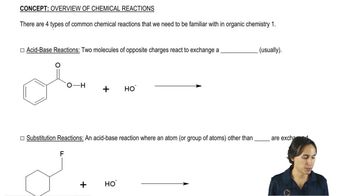
Nucleophiles and Electrophiles can react in Substitution Reactions.

Role of Base in Reactions

In organic reactions, bases like KOEt (potassium ethoxide) are often used to deprotonate alcohols or phenols, enhancing their nucleophilicity. This step is essential for facilitating the nucleophilic attack on the carbonyl compound. The use of a strong base in this reaction indicates that the reaction may proceed more efficiently under high temperature and concentration conditions.
Video consigliato:
02:43
Recognizing Acid-Base Reactions.

Quenching Reactions

Quenching is a process used to stop a chemical reaction, typically by adding a reagent that neutralizes the reactive species. In this case, the addition of H3O+ after the reaction serves to protonate any remaining nucleophiles and stabilize the product. This step is crucial for ensuring that the desired product is obtained in a stable form and to prevent further reactions that could lead to side products.
Video consigliato:
05:09
Heck Reaction