The following steps were used in the synthesis of the antimalarial thiaplakortone A. Identify the missing reagents, (a) and (b),
Ch. 24 - Benzene 2: Reactions Influenced by the Aromatic Ring

Mullins1st EditionOrganic Chemistry: A Learner Centered ApproachISBN: 9780137566471Non è quello che usi tu?Cambia libro di testo
Tutti i libri di testo
Mullins 1st Edition
Ch. 24 - Benzene 2: Reactions Influenced by the Aromatic Ring
Problema 41
Mullins 1st Edition
Ch. 24 - Benzene 2: Reactions Influenced by the Aromatic Ring
Problema 41Capitolo 23, Problema 41
In Chapter 13, we learned that epoxide opening can give different products, depending on whether the reaction occurs under acidic or basic conditions. Explain why the epoxide shown opens identically under either set of conditions.

Guida verificata passo dopo passo1
Step 1: Analyze the structure of the epoxide. The epoxide is a three-membered cyclic ether, which is highly strained and reactive. In this case, the epoxide is attached to a benzene ring and a tertiary carbon, making it asymmetric.
Step 2: Understand the mechanism of epoxide opening under basic conditions. Under basic conditions, the nucleophile (e.g., NaOEt) attacks the less substituted carbon of the epoxide due to steric hindrance. This results in the opening of the ring and formation of a product where the nucleophile is attached to the less substituted carbon.
Step 3: Understand the mechanism of epoxide opening under acidic conditions. Under acidic conditions, the epoxide is protonated first, making it more electrophilic. The nucleophile (e.g., EtOH) then attacks the more substituted carbon of the epoxide due to the stability of the carbocation intermediate formed during the reaction.
Step 4: Explain why the epoxide opens identically under both conditions. In this case, the epoxide is attached to a tertiary carbon and a benzene ring. The benzene ring stabilizes the transition state through resonance, and the tertiary carbon is sterically hindered. These factors make the nucleophile attack the same carbon (the benzylic carbon) under both acidic and basic conditions.
Step 5: Conclude that the identical product formation is due to the unique structure of the epoxide. The benzylic position is both electronically favored (due to resonance stabilization) and sterically accessible compared to the tertiary carbon, leading to the same product regardless of the reaction conditions.

Risposta video verificata per un problema simile:
Questa soluzione video è stata consigliata dai nostri tutor come utile per risolvere questo problema.
Concetti chiave
Ecco i concetti essenziali che devi comprendere per rispondere correttamente alla domanda.
Epoxide Structure and Reactivity
Epoxides are three-membered cyclic ethers that are highly strained due to their angular strain. This strain makes them reactive, allowing them to undergo ring-opening reactions. The reactivity of epoxides is influenced by the nature of the substituents and the conditions under which the reaction occurs, such as acidic or basic environments.
Video consigliato:
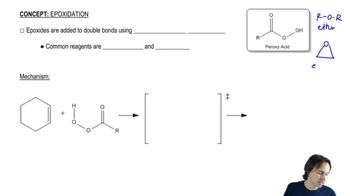
General properties of epoxidation.
Acidic vs. Basic Conditions
In acidic conditions, the epoxide oxygen can be protonated, increasing the electrophilicity of the carbon atoms in the epoxide ring. This makes it easier for nucleophiles to attack. In basic conditions, nucleophiles can directly attack the less hindered carbon atom of the epoxide. Despite the different mechanisms, both conditions can lead to similar products due to the nature of the nucleophilic attack.
Video consigliato:
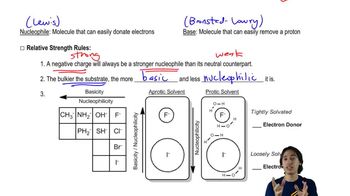
Understanding the difference between basicity and nucleophilicity.
Nucleophilic Attack and Product Formation
The nucleophilic attack on the epoxide can occur at either carbon atom, leading to the opening of the ring. The resulting product depends on the sterics and electronics of the nucleophile and the epoxide. In this case, both acidic and basic conditions yield similar products because the nucleophile can effectively attack the same site, resulting in the same final structure despite the different pathways.
Video consigliato:
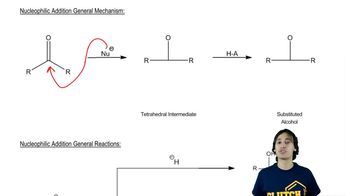
Nucleophilic Addition
Pratica correlata
Domanda del libro di testo
982
views
Domanda del libro di testo
In the second propagation step in the bromination of toluene, Br2 is only attacked by a radical on the substituent carbon. Why?
1179
views
Domanda del libro di testo
The benzylic bromide shown undergoes neither SN1 nor SN2 substitution reactions. Explain.
834
views
Domanda del libro di testo
When (R)-(1-bromoethyl)benzene is treated with sodium cyanide, a single enantiomer is produced. However, upon treatment of the same molecule with water, a mixture of two enantiomers is obtained.
(a) Explain these results.
(b) Why is only partial racemization sometimes observed?
1309
views
Domanda del libro di testo
Beginning with benzene, synthesize the benzyl bromide shown.
1510
views
Domanda del libro di testo
The following reaction proceeds in good yield, despite requiring high temperature and high concentration. Identify the product you’d expect to obtain in this reaction.
514
views