Indietro
 Mullins 1st EditionCh. 3 - Alkanes and Cycloalkanes: Properties and Conformational Analysis
Problema 47d
Represent each of the following condensed structural formulas using a line-angle drawing.
(d) CH3CH2CH2CCH2OH
Problema 47e
Represent each of the following condensed structural formulas using a line-angle drawing.
(e) (CH3)2CHCH2CH2CH2CH2CHO
Problema 48b
For each molecular formula, represent all constitutional isomers using line-angle drawings.
(b) C3H8
Problema 48c
For each molecular formula, represent all constitutional isomers using line-angle drawings.
(c) C4H10
Problema 48e
For each molecular formula, represent all constitutional isomers using line-angle drawings.
(e) C6H14
Problema 49a
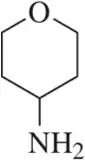
Draw in all missing lone pairs for the following molecules.
(a)
Problema 49b
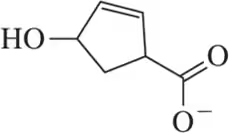
Draw in all missing lone pairs for the following molecules.
(b)
Problema 49c
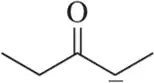
Draw in all missing lone pairs for the following molecules.
(c)
Problema 49d
Draw in all missing lone pairs for the following molecules.
(d)
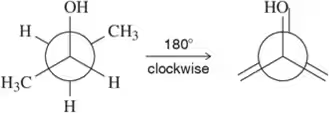
Problema 50a
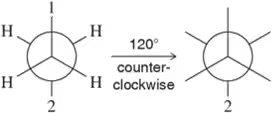
Given the first Newman projection and the direction and degree of rotation, fill in the resulting Newman projection. [One substituent has been labeled for you.]
(a)
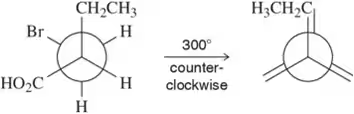
Problema 50d
Given the first Newman projection and the direction and degree of rotation, fill in the resulting Newman projection. [One substituent has been labeled for you.]
(d)
Problema 50h
Given the first Newman projection and the direction and degree of rotation, fill in the resulting Newman projection. [One substituent has been labeled for you.]
(h)
Problema 50l
Given the first Newman projection and the direction and degree of rotation, fill in the resulting Newman projection. [One substituent has been labeled for you.]
(l)
Problema 52d
For each of the following structures, which staggered Newman projection skeleton from Assessment 3.51 should you draw first to show what is seen when looking down the indicated bond?
(d) <IMAGE>
Problema 53b
Given the following structures, show the Newman projection that would result from looking down the indicated bond in the direction shown. [Orient yourself as if you were the eyeball looking down the bond. Some of the examples have been partially completed for you to fill in the rest.]
(b) <IMAGE>
Problema 53i
Given the following structures, show the Newman projection that would result from looking down the indicated bond in the direction shown. [Orient yourself as if you were the eyeball looking down the bond. Some of the examples have been partially completed for you to fill in the rest.]
(i) <IMAGE>
Problema 53j
Given the following structures, show the Newman projection that would result from looking down the indicated bond in the direction shown. [Orient yourself as if you were the eyeball looking down the bond. Some of the examples have been partially completed for you to fill in the rest.]
(j) <IMAGE>
Problema 53k
Given the following structures, show the Newman projection that would result from looking down the indicated bond in the direction shown. [Orient yourself as if you were the eyeball looking down the bond. Some of the examples have been partially completed for you to fill in the rest.]
(k) <IMAGE>
Problema 53l
Given the following structures, show the Newman projection that would result from looking down the indicated bond in the direction shown. [Orient yourself as if you were the eyeball looking down the bond. Some of the examples have been partially completed for you to fill in the rest.]
(l) <IMAGE>
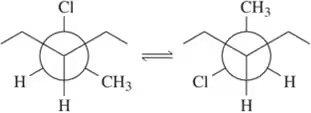
Problema 54e
For each pair of conformations shown, choose which is most stable. [If both conformations have the same number of gauche interactions, choose the one where the interactions are between smaller groups.]
(e)
Problema 54f
For each pair of conformations shown, choose which is most stable. [If both conformations have the same number of gauche interactions, choose the one where the interactions are between smaller groups.]
(f)
Problema 55b
Looking down the indicated bond, show the three most stable conformations and choose the one that is most stable. Be sure that the first Newman projection you show is the one you see initially (before rotation). [Why should none of your three Newman projections show eclipsed conformations?]
(b) <IMAGE>
Problema 55e
Looking down the indicated bond, show the three most stable conformations and choose the one that is most stable. Be sure that the first Newman projection you show is the one you see initially (before rotation). [Why should none of your three Newman projections show eclipsed conformations?]
(e) <IMAGE>
Problema 56
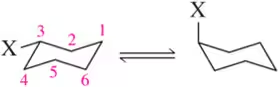
Using the numbers shown in the chair conformation on the left, label the carbons of the flipped chair on the right. [Assume that the angle through which you view the chair conformation doesn't change.]
Problema 57c
For each chair on the left, place the substituents on the flipped chair. [Recall that the axial/equatorial designation changes from one chair to the next, but the carbon to which the substituent is attached does not.]
(c)
Problema 57e
For each chair on the left, place the substituents on the flipped chair. [Recall that the axial/equatorial designation changes from one chair to the next, but the carbon to which the substituent is attached does not.]
(e)
Problema 57f
For each chair on the left, place the substituents on the flipped chair. [Recall that the axial/equatorial designation changes from one chair to the next, but the carbon to which the substituent is attached does not.]
(f)
Problema 58a
What is the mistake that was made in drawing each of the flipped chairs on the right from the chair on the left? [In these, assume that the angle through which you view the chair conformations doesn't change.]
(a)
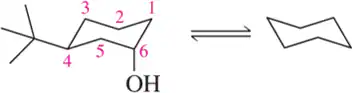
Problema 59e
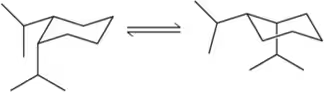
For each pair of conformations shown, choose which is most stable. If both are equally stable, then write 'no difference.' [If both conformations have the same number of axial substituents, choose the one with the smallest axial substituents.]
(e)
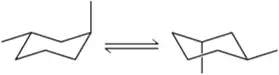
Problema 59g
For each pair of conformations shown, choose which is most stable. If both are equally stable, then write 'no difference.' [If both conformations have the same number of axial substituents, choose the one with the smallest axial substituents.]
(g)