Indietro
 Mullins 1st EditionCh. 3 - Alkanes and Cycloalkanes: Properties and Conformational Analysis
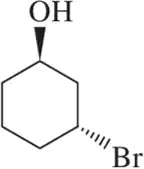
Problema 60e
For each structure shown, draw the two chair conformations and choose which is most stable. Be sure that your second chair is the flipped version of the first. [Make sure that wedged substituents are up in the chair, regardless of whether up is equatorial or axial.]
(e)
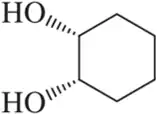
Problema 60g
For each structure shown, draw the two chair conformations and choose which is most stable. Be sure that your second chair is the flipped version of the first. [Make sure that wedged substituents are up in the chair, regardless of whether up is equatorial or axial.]
(g)
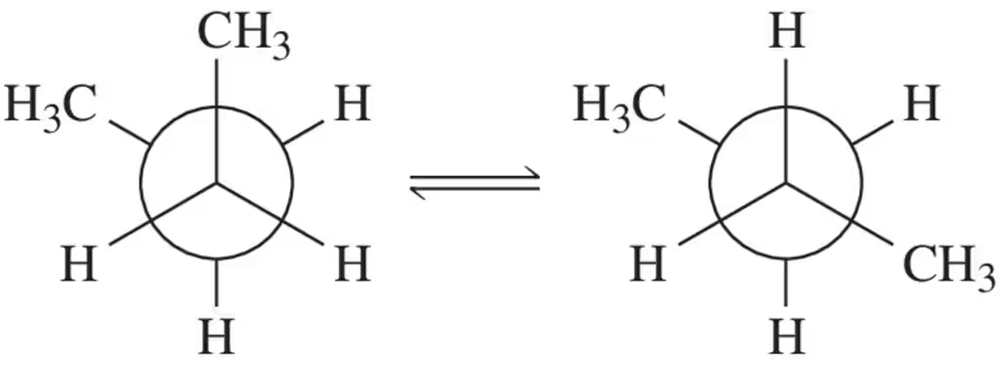
Problema 61b
Calculate the energy difference between each pair of conformations shown by drawing and comparing Newman projections down the indicated bonds in each.
(b)
Problema 63
In contrast to ethane and other alkanes studied in this chapter, there is no free rotation around any bonds in cyclopentane (shown below). Why?
Problema 64
Looking ahead In Chapter 5, we explain that the equilibrium constant (Keq) for a reaction can be calculated based on the difference in energy between reactants and products, according to the following equation:
Using this equation, calculate the equilibrium constant for the 'reaction' shown. [For the rest of the book, if not otherwise specified, assume room temperature (298K).]
Problema 67
The normal C(sp3)–C(sp3) bond length is 1.54 Å. The normal bond angle for an sp3-hybridized carbon is 109.5°. The following molecule experiences large deviations from these normal values. Explain these deviations. [Molecular models would be helpful here.]
Problema 69
In Chapter 5, we introduce reaction coordinate diagrams as a plot of potential energy versus the progress of a reaction. Consider the reaction coordinate diagram drawn for the 'reaction' of conformation A becoming conformation B. Which structure is present at the top of the hill?
<IMAGE>
Problema 71
Correct the following incorrect names using standard IUPAC nomenclature. [Draw a compound that corresponds to the incorrect name, and then rename it.]
(a) 4-methylhexane
Problema 71b
Correct the following incorrect names using standard IUPAC nomenclature. [Draw a compound that corresponds to the incorrect name, and then rename it.]
(b) 1,5-dimethylcyclohexane
Problema 71c
Correct the following incorrect names using standard IUPAC nomenclature. [Draw a compound that corresponds to the incorrect name, and then rename it.]
(c) 6-ethyl-3-methyloctane
Problema 71d
Correct the following incorrect names using standard IUPAC nomenclature. [Draw a compound that corresponds to the incorrect name, and then rename it.]
(d) 4-butyldecane
Problema 71e
Correct the following incorrect names using standard IUPAC nomenclature. [Draw a compound that corresponds to the incorrect name, and then rename it.]
(e) 2,6-diethyl-1-methylcycloheptane
Problema 72a
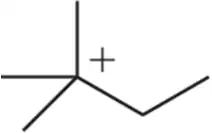
Identify the mistakes contained within the following structures.
(a)
Problema 73
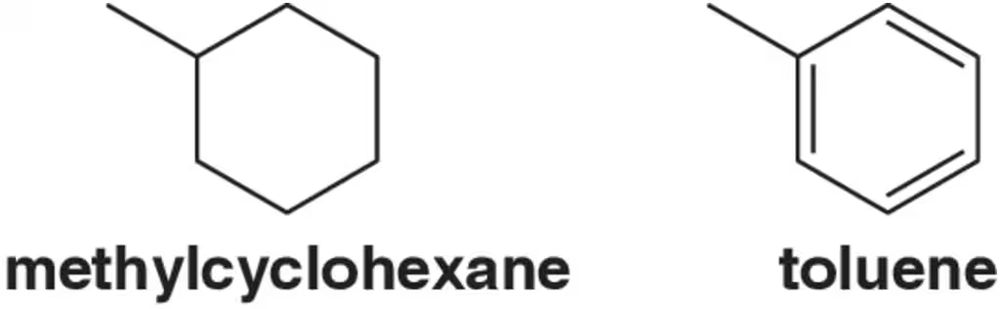
Despite methylcyclohexane (98.2 amu) having a higher molecular weight than toluene (92.1 amu), toluene melts at a higher temperature. Why? [Think about how the molecules can interact with each other based on their shape.]
Problema 74
Ionic compounds like sodium acetate have a high melting point. Despite this, they are highly soluble in water. Why?

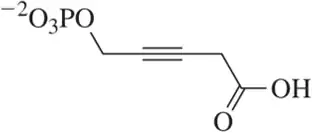
Problema 75a
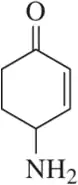
Identify the functional groups in each of the following molecules. [The number of functional groups has been given to assist you.]
(a) [Three]
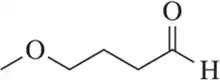
Problema 75b
Identify the functional groups in each of the following molecules. [The number of functional groups has been given to assist you.]
(b) [Two]
Problema 75c
Identify the functional groups in each of the following molecules. [The number of functional groups has been given to assist you.]
(c) [Three]
Problema 75d
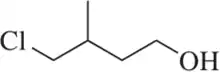
Identify the functional groups in each of the following molecules. [The number of functional groups has been given to assist you.]
(d) [Two]