Ch. 4 - Acids and Bases/Electron Flow
Mullins - Organic Chemistry: A Learner Centered Approach 1st Edition
Mullins1st EditionOrganic Chemistry: A Learner Centered ApproachISBN: 9780137566471Non è quello che usi tu?Cambia libro di testo
Capitolo 3, Problema 20d

In the following reactions,
(i) identify the acid and base,
(ii) identify the most electron-rich atom in the base,
(iii) identify the most acidic hydrogen in the acid,
(iv) provide an arrow-pushing mechanism of the proton transfer that will occur, and
(v) predict the product of the reactions. [You'll need to provide the lone pairs here.]
(d) H2O + HCl ⇌

Guida verificata passo dopo passo
1
Step 1: Identify the acid and base in the reaction. HCl is the acid because it donates a proton (H⁺), and H₂O is the base because it accepts the proton.
Step 2: Determine the most electron-rich atom in the base. In H₂O, the oxygen atom is the most electron-rich because it has lone pairs of electrons.
Step 3: Identify the most acidic hydrogen in the acid. In HCl, the hydrogen atom is bonded to a highly electronegative chlorine atom, making it the most acidic hydrogen.
Step 4: Provide the arrow-pushing mechanism for the proton transfer. Draw a curved arrow from one of the lone pairs on the oxygen atom of H₂O to the hydrogen atom of HCl, indicating the formation of a bond. Simultaneously, draw another curved arrow from the H-Cl bond to the chlorine atom, showing the bond breaking and the formation of Cl⁻.
Step 5: Predict the products of the reaction. The proton transfer results in the formation of H₃O⁺ (hydronium ion) and Cl⁻ (chloride ion). Ensure to include the lone pairs on the oxygen atom in H₃O⁺ and the chloride ion.

Risposta video verificata per un problema simile:

Questa soluzione video è stata consigliata dai nostri tutor come utile per risolvere questo problema.

Concetti chiave

Ecco i concetti essenziali che devi comprendere per rispondere correttamente alla domanda.

Acids and Bases

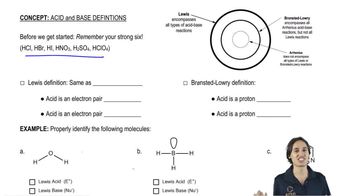
In organic chemistry, acids are substances that can donate a proton (H+) to a base, which is a substance that can accept a proton. The Brønsted-Lowry theory defines acids as proton donors and bases as proton acceptors. Understanding the roles of acids and bases in a reaction is crucial for predicting the outcome and identifying the reactants involved.
Video consigliato:
02:49
The Lewis definition of acids and bases.

Electron-Rich Atoms

The most electron-rich atom in a base is typically a nitrogen or oxygen atom that possesses lone pairs of electrons. These lone pairs are available to bond with protons, making these atoms nucleophilic. Identifying the most electron-rich atom is essential for understanding how the base will interact with the acid during the proton transfer process.
Video consigliato:
01:44
The difference between atomic numbers and atomic mass.

Arrow-Pushing Mechanism

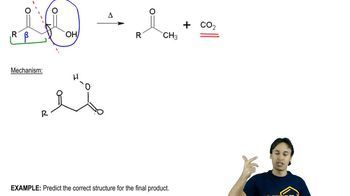
The arrow-pushing mechanism is a way to illustrate the movement of electrons during a chemical reaction. In the context of acid-base reactions, arrows are used to show the transfer of a proton from the acid to the base. This visual representation helps in understanding the reaction pathway and predicting the products formed after the proton transfer.
Video consigliato:
04:32
General Mechanism