Domanda del libro di testo
In the following reactions,
(iv) provide an arrow-pushing mechanism of the proton transfer that will occur, and
(v) predict the product of the reactions. [You'll need to provide the lone pairs here.]
(b)
1324
views

 Mullins 1st EditionCh. 4 - Acids and Bases/Electron FlowProblema 20c(i,ii,iii)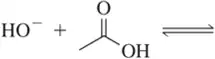
 Guida verificata passo dopo passo
 02:49
02:49
 01:44
01:44 00:48
00:48In the following reactions,
(iv) provide an arrow-pushing mechanism of the proton transfer that will occur, and
(v) predict the product of the reactions. [You'll need to provide the lone pairs here.]
(b)
Write the Keq expression for the following acid–base reactions. [You don't need to calculate Keq here.]
(c)
In the following reactions,
(iv) provide an arrow-pushing mechanism of the proton transfer that will occur, and
(v) predict the product of the reactions. [You'll need to provide the lone pairs here.]
(c)
In the following reactions,
(i) identify the acid and base,
(ii) identify the most electron-rich atom in the base,
(iii) identify the most acidic hydrogen in the acid,
(iv) provide an arrow-pushing mechanism of the proton transfer that will occur, and
(v) predict the product of the reactions. [You'll need to provide the lone pairs here.]
(d) H2O + HCl ⇌
Given the value of Keq for the following acid–base reactions, identify the weakest acid and the weakest base.
(a)
In the following reactions,
(i) identify the acid and base,
(ii) identify the most electron-rich atom in the base,
(iii) identify the most acidic hydrogen in the acid,
(b)