Indietro
Problema 45l(vii,viii)
Predict the product(s) that would result when the alkenes are allowed to react under the following conditions: (vii) 1. mCPBA 2. H2SO4, H2O (viii) 1. O3 2. CH3SCH3
(l)
Problema 46
Rank the reactivity of the following alkenes with mCPBA ( 1 = most reactive , 5 least reactive ).
Problema 47
When alkenes react with bromine in water, a halohydrin is produced. When water is replaced with methanol in this reaction, a different product is produced. Suggest a mechanism for the formation of this product.
Problema 48a
In light of your answer to Assessment 9.47, predict the product of the following reactions we have seen previously where an alcohol is substituted for water.
(a)
Problema 48b
In light of your answer to Assessment 9.47, predict the product of the following reactions we have seen previously where an alcohol is substituted for water.
(b)
Problema 48c
In light of your answer to Assessment 9.47, predict the product of the following reactions we have seen previously where an alcohol is substituted for water.
(c)
Problema 50a
One way to think about concerted reactions is to imagine them as being stepwise reactions where, besides the slowest step, all others have infinitesimally small activation energies. Considering the hypothetical stepwise mechanism and actual concerted mechanism of epoxide formation, show what a reaction coordinate diagram might look like for each possibility.
(a) Stepwise, hypothetical mechanism:
Problema 50b
One way to think about concerted reactions is to imagine them as being stepwise reactions where, besides the slowest step, all others have infinitesimally small activation energies. Considering the hypothetical stepwise mechanism and actual concerted mechanism of epoxide formation, show what a reaction coordinate diagram might look like for each possibility.
(b) Concerted , actual mechanism (butterfly transition state:
Problema 51
Consider the Cope rearrangement, a reaction we describe in Chapter 20.
(a) Using the knowledge we have gained here in Chapter 9, suggest a one-step, concerted mechanism that explains the formation of B from A.
(b) Which side of the reaction would you expect to be favored? Justify your answer.
(c) Which product, A or B, would you expect to be hydrogenated with the more exothermic heat of hydrogenation?
Problema 52a
Bromination of buta-1,3-diene with a single equivalent of Br2 can give either of two products. (a) Which of these products (A or B) would you predict to be more stable? Justify your answer.
Problema 53
Bromination of a highly electron-rich alkene such as 2-methoxybut-2-ene has been shown to produce approximately equal mixtures of the trans- and cis-dibromide. Suggest an explanation for this observation.
Problema 54
In Chapter 19, we discuss the reaction of enols with bromine. This reaction produces α -bromoketones in good yields. Suggest a mechanism for this reaction and justify its deviation from the dibromide product you might have expected.
Problema 55
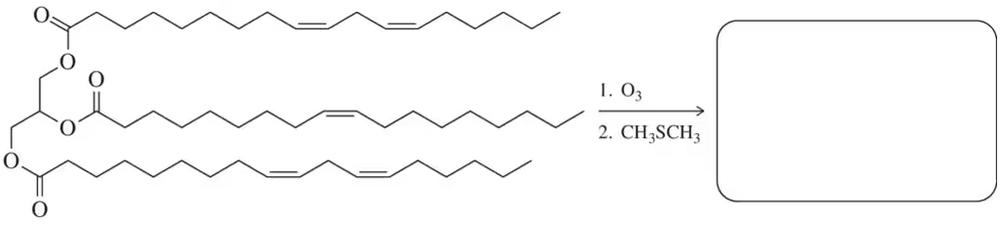
Predict the product of ozonolysis of the triglyceride shown.
Problema 56
Ozonolysis of an unknown alkene A gives the products shown. Predict the product that results from hydrogenation of alkene A. [There are multiple answers, but only show the one with the 6-membered ring.]
Problema 57
In spite of being mechanistically similar to some of the reactions we saw in Chapter 8, rearrangement never occurred here in Chapter 9. Why doesn't rearrangement occur in the following bromination reaction despite the proximity of a more substituted carbon?
Problema 59a
At the beginning of Chapter 9, we stated that after finishing Chapters 8 and 9, we would have the ability to make a large variety of functional groups using related reactions. Show the reagent(s) necessary to convert 1-isobutylcyclohexene into the following molecules.
(a)
Problema 59b
At the beginning of Chapter 9, we stated that after finishing Chapters 8 and 9, we would have the ability to make a large variety of functional groups using related reactions. Show the reagent(s) necessary to convert 1-isobutylcyclohexene into the following molecules.
(b)
Problema 59c
At the beginning of Chapter 9, we stated that after finishing Chapters 8 and 9, we would have the ability to make a large variety of functional groups using related reactions. Show the reagent(s) necessary to convert 1-isobutylcyclohexene into the following molecules.
(c)
Problema 59d
At the beginning of Chapter 9, we stated that after finishing Chapters 8 and 9, we would have the ability to make a large variety of functional groups using related reactions. Show the reagent(s) necessary to convert 1-isobutylcyclohexene into the following molecules.
(d)
Problema 59e
At the beginning of Chapter 9, we stated that after finishing Chapters 8 and 9, we would have the ability to make a large variety of functional groups using related reactions. Show the reagent(s) necessary to convert 1-isobutylcyclohexene into the following molecules.
(e)
Problema 59f
At the beginning of Chapter 9, we stated that after finishing Chapters 8 and 9, we would have the ability to make a large variety of functional groups using related reactions. Show the reagent(s) necessary to convert 1-isobutylcyclohexene into the following molecules.
(f)
Problema 59g
At the beginning of Chapter 9, we stated that after finishing Chapters 8 and 9, we would have the ability to make a large variety of functional groups using related reactions. Show the reagent(s) necessary to convert 1-isobutylcyclohexene into the following molecules.
(g)
Problema 59h
At the beginning of Chapter 9, we stated that after finishing Chapters 8 and 9, we would have the ability to make a large variety of functional groups using related reactions. Show the reagent(s) necessary to convert 1-isobutylcyclohexene into the following molecules.
(h)
Problema 60a
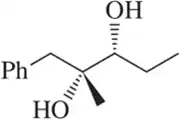
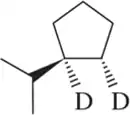
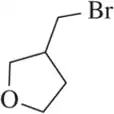
Retrosynthetic analysis is the process of working backward to develop the synthesis of a new compound. In Chapter 10, we begin developing multistep syntheses in this manner. For now, try to work backward a single step by suggesting an alkene and a reagent that would give products (a)–(i). [Your answers should not include alkenes that undergo rearrangement to give the desired products.]
(a)
Problema 60b
Retrosynthetic analysis is the process of working backward to develop the synthesis of a new compound. In Chapter 10, we begin developing multistep syntheses in this manner. For now, try to work backward a single step by suggesting an alkene and a reagent that would give products (a)–(i). [Your answers should not include alkenes that undergo rearrangement to give the desired products.]
(b)
Problema 60d
Retrosynthetic analysis is the process of working backward to develop the synthesis of a new compound. In Chapter 10, we begin developing multistep syntheses in this manner. For now, try to work backward a single step by suggesting an alkene and a reagent that would give products (a)–(i). [Your answers should not include alkenes that undergo rearrangement to give the desired products.]
(d)
Problema 60f
Retrosynthetic analysis is the process of working backward to develop the synthesis of a new compound. In Chapter 10, we begin developing multistep syntheses in this manner. For now, try to work backward a single step by suggesting an alkene and a reagent that would give products (a)–(i). [Your answers should not include alkenes that undergo rearrangement to give the desired products.]
(f)
Problema 60i
Retrosynthetic analysis is the process of working backward to develop the synthesis of a new compound. In Chapter 10, we begin developing multistep syntheses in this manner. For now, try to work backward a single step by suggesting an alkene and a reagent that would give products (a)–(i). [Your answers should not include alkenes that undergo rearrangement to give the desired products.]
(i)
Problema 61a
Suggest mechanisms for the following reactions, which are similar to the mechanism we saw for lanosterol biosynthesis at the end of Chapter 8.
(a)
Problema 61b
Suggest mechanisms for the following reactions, which are similar to the mechanism we saw for lanosterol biosynthesis at the end of Chapter 8.
(b)