Ch.11 - Reactions of Alcohols
Wade - Organic Chemistry 9th Edition
Wade9th EditionOrganic ChemistryISBN: 9780135213728Non è quello che usi tu?Cambia libro di testo
Capitolo 11, Problema 41a,b

In each case, show how you would synthesize the chloride, bromide, and iodide from the corresponding alcohol.
(a) 1-halobutane (halo = chloro, bromo, iodo)
(b) halocyclopentane

Guida verificata passo dopo passo
1
Step 1: Recognize that the synthesis of alkyl halides (chlorides, bromides, and iodides) from alcohols typically involves substitution reactions where the hydroxyl group (-OH) is replaced by a halogen atom. Common reagents for this transformation include thionyl chloride (SOCl₂), phosphorus tribromide (PBr₃), and iodine with phosphorus (I₂/P).
Step 2: For part (a), 1-halobutane: Start with 1-butanol (CH₃CH₂CH₂CH₂OH). To synthesize 1-chlorobutane, react 1-butanol with thionyl chloride (SOCl₂) in the presence of pyridine. The reaction proceeds via an SN2 mechanism, replacing the -OH group with a chlorine atom.
Step 3: For 1-bromobutane, react 1-butanol with phosphorus tribromide (PBr₃). This reaction also proceeds via an SN2 mechanism, where the hydroxyl group is replaced by a bromine atom.
Step 4: To synthesize 1-iodobutane, react 1-butanol with iodine (I₂) and red phosphorus (P). The phosphorus reacts with iodine to form PI₃ in situ, which then substitutes the hydroxyl group with an iodine atom.
Step 5: For part (b), halocyclopentane: Start with cyclopentanol (C₅H₁₀OH). Follow the same procedures as above for each halogen: (i) React cyclopentanol with SOCl₂ for chlorocyclopentane, (ii) React cyclopentanol with PBr₃ for bromocyclopentane, and (iii) React cyclopentanol with I₂/P for iodocyclopentane.

Risposta video verificata per un problema simile:

Questa soluzione video è stata consigliata dai nostri tutor come utile per risolvere questo problema.
Durata del video:
5m

Concetti chiave

Ecco i concetti essenziali che devi comprendere per rispondere correttamente alla domanda.

Nucleophilic Substitution Reactions

Nucleophilic substitution reactions involve the replacement of a leaving group in a molecule with a nucleophile. In the context of synthesizing halides from alcohols, the hydroxyl group (-OH) of the alcohol acts as the leaving group, while halide ions (Cl-, Br-, I-) serve as nucleophiles. Understanding the mechanism (SN1 or SN2) is crucial, as it influences the reaction conditions and the structure of the starting alcohol.
Video consigliato:
01:47
Nucleophiles and Electrophiles can react in Substitution Reactions.

Conversion of Alcohols to Halides

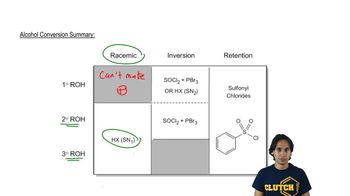
Alcohols can be converted to alkyl halides through various methods, including the use of reagents like thionyl chloride (SOCl2), phosphorus tribromide (PBr3), or hydrohalic acids (HCl, HBr, HI). These reagents facilitate the substitution of the hydroxyl group with a halogen, effectively transforming the alcohol into the desired halide. The choice of reagent often depends on the type of halide being synthesized and the structure of the alcohol.
Video consigliato:
04:30
Comparing and contrasting the Alcohol Conversions.

Stereochemistry and Reactivity

The stereochemistry of the starting alcohol can significantly affect the outcome of the halide synthesis. For example, primary alcohols typically undergo SN2 reactions, leading to inversion of configuration, while tertiary alcohols often proceed via SN1 mechanisms, resulting in racemization. Understanding the reactivity patterns and stereochemical implications is essential for predicting the products of the halide synthesis from alcohols.
Video consigliato:
Percorso guidato
1:38
Polymer Stereochemistry Concept 1