

Ch.11 - Reactions of Alcohols
Wade - Organic Chemistry 9th Edition
Wade9th EditionOrganic ChemistryISBN: 9780135213728Non è quello che usi tu?Cambia libro di testo
Capitolo 11, Problema 40d

Show how you would convert 2-methylcyclopentanol to the following products. Any of these products may be used as the reactant in any subsequent part of this problem.
d. 1-methylcyclopentanol

Guida verificata passo dopo passo
1
Step 1: Recognize that the problem involves a rearrangement of the methyl group from the 2-position to the 1-position on the cyclopentanol ring. This suggests that a carbocation rearrangement might be involved.
Step 2: Begin by protonating the hydroxyl group (-OH) of 2-methylcyclopentanol using an acid catalyst (e.g., H₂SO₄ or H₃PO₄). This converts the hydroxyl group into a better leaving group, forming water (H₂O).
Step 3: Once the hydroxyl group leaves, a carbocation intermediate is formed at the 2-position of the cyclopentane ring. This is a secondary carbocation.
Step 4: A 1,2-hydride shift occurs, where a hydrogen atom from the 1-position migrates to the 2-position. This stabilizes the carbocation by forming a more stable tertiary carbocation at the 1-position.
Step 5: Finally, water (H₂O) or another nucleophile can attack the carbocation at the 1-position, leading to the formation of 1-methylcyclopentanol as the product.

Risposta video verificata per un problema simile:

Questa soluzione video è stata consigliata dai nostri tutor come utile per risolvere questo problema.
Durata del video:
3m

Concetti chiave

Ecco i concetti essenziali che devi comprendere per rispondere correttamente alla domanda.

Alcohols and Their Reactions

Alcohols are organic compounds containing a hydroxyl (-OH) group. They can undergo various reactions, including dehydration, oxidation, and substitution. Understanding the reactivity of alcohols is crucial for converting one alcohol to another, as different reaction pathways can lead to the desired product.
Video consigliato:
01:44
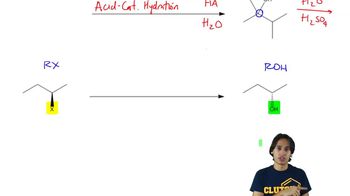
Forming alcohols through SN2 reactions.

Isomerism in Organic Chemistry

Isomerism refers to the existence of compounds with the same molecular formula but different structural arrangements. In this case, 2-methylcyclopentanol and 1-methylcyclopentanol are structural isomers. Recognizing isomerism is essential for understanding how to manipulate molecular structures to achieve specific transformations.
Video consigliato:
00:56
What is an organic molecule?

Nucleophilic Substitution Reactions

Nucleophilic substitution reactions involve the replacement of a leaving group by a nucleophile. In the context of alcohols, this can occur through mechanisms such as SN1 or SN2. Knowing how to apply these mechanisms allows for the conversion of one alcohol to another by effectively substituting functional groups.
Video consigliato:
01:47
Nucleophiles and Electrophiles can react in Substitution Reactions.