
Ch.11 - Reactions of Alcohols
Wade - Organic Chemistry 9th Edition
Wade9th EditionOrganic ChemistryISBN: 9780135213728Non è quello che usi tu?Cambia libro di testo
Capitolo 11, Problema 40a,b,c

Show how you would convert 2-methylcyclopentanol to the following products. Any of these products may be used as the reactant in any subsequent part of this problem.
a. 1-methylcyclopentene
b. 2-methylcyclopentyl tosylate
c. 2-methylcyclopentanone

Guida verificata passo dopo passo
1
Step 1: To convert 2-methylcyclopentanol to 1-methylcyclopentene (product a), perform an acid-catalyzed dehydration reaction. Use a strong acid like H₂SO₄ or H₃PO₄ to protonate the hydroxyl group, creating a good leaving group (water). Then, the carbocation intermediate undergoes rearrangement to form the more stable tertiary carbocation, followed by elimination of a proton to yield the alkene.
Step 2: To convert 2-methylcyclopentanol to 2-methylcyclopentyl tosylate (product b), react the alcohol with p-toluenesulfonyl chloride (TsCl) in the presence of a base like pyridine. This reaction replaces the hydroxyl group with a tosyl group (-OTs), creating a good leaving group for subsequent substitution or elimination reactions.
Step 3: To convert 2-methylcyclopentanol to 2-methylcyclopentanone (product c), perform an oxidation reaction. Use an oxidizing agent such as PCC (pyridinium chlorochromate) or Jones reagent (CrO₃/H₂SO₄) to oxidize the secondary alcohol to a ketone. Ensure mild conditions to avoid overoxidation.
Step 4: Recognize that any of the products (a, b, or c) can be used as reactants for further transformations. For example, 1-methylcyclopentene can undergo hydroboration-oxidation to form an alcohol, or 2-methylcyclopentyl tosylate can undergo nucleophilic substitution to introduce new functional groups.
Step 5: Carefully analyze the reaction conditions and mechanisms for each transformation to ensure proper stereochemistry and regioselectivity, especially in cases involving carbocation rearrangements or oxidation reactions.

Risposta video verificata per un problema simile:

Questa soluzione video è stata consigliata dai nostri tutor come utile per risolvere questo problema.
Durata del video:
6m

Concetti chiave

Ecco i concetti essenziali che devi comprendere per rispondere correttamente alla domanda.

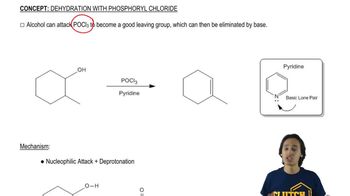
Alcohol Dehydration

Alcohol dehydration is a key reaction in organic chemistry where an alcohol is converted into an alkene through the elimination of water. In the case of converting 2-methylcyclopentanol to 1-methylcyclopentene, this process typically involves heating the alcohol with an acid catalyst, leading to the formation of a double bond and the release of water.
Video consigliato:
01:23
General Reaction of Dehydration with POCl3

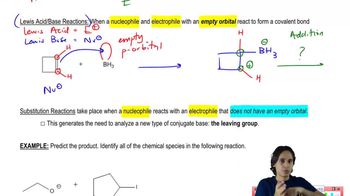
Nucleophilic Substitution

Nucleophilic substitution is a fundamental reaction mechanism in organic chemistry where a nucleophile replaces a leaving group in a molecule. For the conversion of 2-methylcyclopentanol to 2-methylcyclopentyl tosylate, the hydroxyl group of the alcohol is converted into a better leaving group (tosylate) through reaction with tosyl chloride, facilitating subsequent nucleophilic attack.
Video consigliato:
01:47
Nucleophiles and Electrophiles can react in Substitution Reactions.

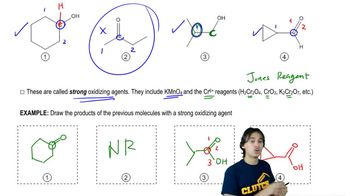
Oxidation of Alcohols

The oxidation of alcohols is a process where alcohols are converted into carbonyl compounds, such as ketones or aldehydes, by the addition of oxidizing agents. To convert 2-methylcyclopentanol to 2-methylcyclopentanone, an oxidizing agent like chromic acid or PCC can be used to facilitate the transformation, resulting in the formation of a ketone.
Video consigliato:
05:53
Strong oxidizing agents