Indietro
Problema 20a
Draw the following sugars using Haworth projections:
a. β-D-galactopyranose
Problema 20b
Draw the following sugars using Haworth projections:
b. α-D-tagatopyranose
Problema 21a1
Show how the following ketones might be synthesized from the indicated acids, using any necessary reagents.
(a) propiophenone from propionic acid (using alkylation of the acid)
Problema 21b
Show how the following ketones might be synthesized from the indicated acids, using any necessary reagents.
(b) methyl cyclohexyl ketone from cyclohexanecarboxylic acid
Problema 22
Propose a mechanism for the reaction of benzoic acid with oxalyl chloride. This mechanism begins like the thionyl chloride reaction, to give a reactive mixed anhydride. Nucleophilic acyl substitution by chloride ion gives a tetrahedral intermediate that eliminates a leaving group, which then fragments into carbon dioxide, carbon monoxide, and chloride ion.
Problema 23a
Propose mechanisms for the nucleophilic acyl substitutions to form ethyl benzoate as shown on the previous page.
Problema 23b
Propose mechanisms for the nucleophilic acyl substitutions to form N-methylacetamide as shown on the previous page.
Problema 24a
Show how you would use an acid chloride as an intermediate to synthesize.
(a) N-phenylbenzamide (PhCONHPh) from benzoic acid and aniline.
Problema 24b
Show how you would use an acid chloride as an intermediate to synthesize
(b) phenyl propionate (CH3CH2COOPh) from propionic acid and phenol.
Problema 25a,b
Give the IUPAC names of the following compounds.
(a) CH3CH2C≡CCOOH
(b) CH3CH(NH2)CH(OH)COOH
Problema 25c,d
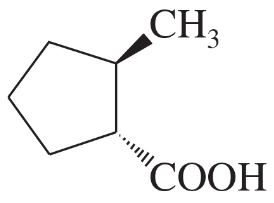
Give the IUPAC names of the following compounds.
(c) (CH3)2C=CHCOOH
(d)
Problema 25e,f
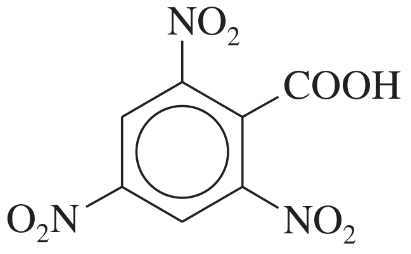
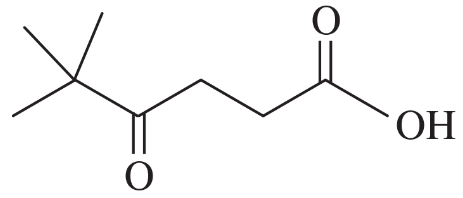
Give the IUPAC names of the following compounds.
(e)
(f)
Problema 27f-i
Draw the structures of the following compounds.
(f) salicylic acid
(g) zinc undecanoate (athlete's-foot powder)
(h) sodium benzoate (a food preservative)
(i) sodium fluoroacetate (Compound 1080, a controversial coyote poison)
Problema 28
Show how you would use extractions with a separatory funnel to separate a mixture of the following compounds: benzoic acid, phenol, benzyl alcohol, aniline
Problema 29c,d
Arrange each group of compounds in order of increasing basicity.
c. sodium benzoate, sodium ethoxide, and sodium phenoxide
d. pyridine, sodium ethoxide, and sodium acetate
Problema 30a,b,c
Predict the products (if any) of the following acid–base reactions.
(a) acetic acid + ammonia
(b) phthalic acid + excess NaOH
(c) p-toluic acid + potassium trifluoroacetate
Problema 30d,e
Predict the products (if any) of the following acid–base reactions.
(d) α-bromopropionic acid + sodium propionate
(e) benzoic acid + sodium phenoxide
Problema 31
Rank the following isomers in order of increasing boiling point, and explain the reasons for your order of ranking.
Problema 32
Arrange each group of compounds in order of increasing acidity.
(a) phenol, ethanol, acetic acid
(b) p-toluenesulfonic acid, acetic acid, chloroacetic acid
(c) benzoic acid, o-nitrobenzoic acid, m-nitrobenzoic acid
(d) butyric acid, α-bromobutyric acid, β-bromobutyric acid
(e)
Problema 34a,b
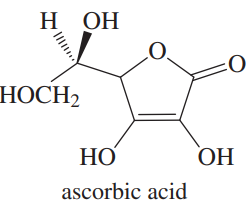
Given the structure of ascorbic acid (vitamin C):
(a) Is ascorbic acid a carboxylic acid?
(b) Compare the acid strength of ascorbic acid (pKa = 4.71) with acetic acid.
Problema 34c,d
Given the structure of ascorbic acid (vitamin C):
(c) Predict which proton in ascorbic acid is the most acidic.
(d) Draw the form of ascorbic acid that is present in the body (aqueous solution, pH = 7.4)
Problema 36a
Show how you would accomplish the following syntheses efficiently (you may use any necessary reagents).
(a) trans-1-bromobut-2-ene → trans-pent-3-enoic acid (two ways)
Problema 36b
Show how you would accomplish the following syntheses efficiently (you may use any necessary reagents).
(b) hex-3-ene → propanoic acid
Problema 36c
Show how you would accomplish the following syntheses efficiently (you may use any necessary reagents).
(c) but-2-enal → but-2-enoic acid
Problema 36d
Show how you would accomplish the following syntheses efficiently (you may use any necessary reagents).
(d) hexanoic acid → hexanal
Problema 36e
Show how you would accomplish the following syntheses efficiently (you may use any necessary reagents).
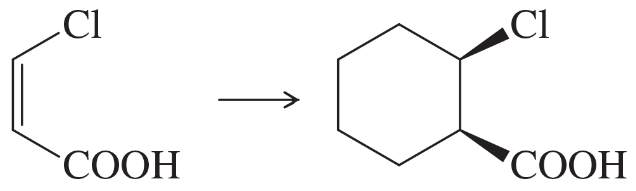
(e)
Problema 36f
Show how you would accomplish the following syntheses efficiently (you may use any necessary reagents).
(f)
Problema 36g
Show how you would accomplish the following syntheses efficiently (you may use any necessary reagents).
(g)
Problema 36h
Show how you would accomplish the following syntheses efficiently (you may use any necessary reagents).
(h)
Problema 37a
Predict the products and propose mechanisms for the following reactions.
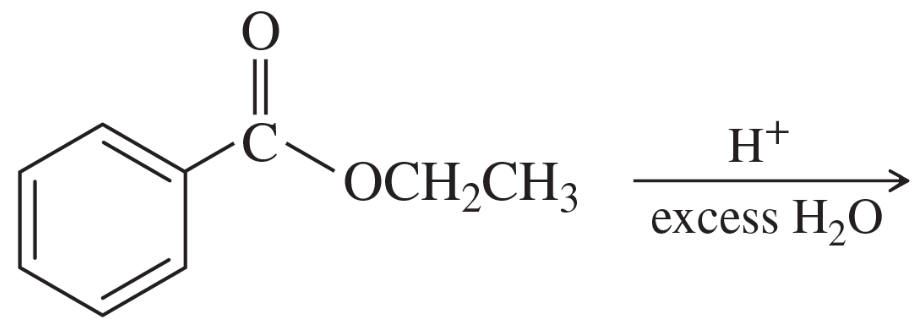
(a)