Ch 26: Potential and Field
Knight Calc - Physics for Scientists and Engineers 5th Edition
Knight Calc5th EditionPhysics for Scientists and EngineersISBN: 9780137344796Non è quello che usi tu?Cambia libro di testo
Capitolo 26, Problema 15

The electric potential along the x-axis is V = 100x2 V, where x is in meters. What is Ex at (a) x=0 m and (b) x=1 m?

Guida verificata passo dopo passo
1
Step 1: Recall the relationship between electric potential (V) and electric field (E). The electric field is the negative gradient of the electric potential. Mathematically, this is expressed as: E_x = -dV/dx, where E_x is the electric field along the x-axis and V is the electric potential.
Step 2: Differentiate the given electric potential function V = 100x^2 with respect to x. The derivative is: dV/dx = 200x.
Step 3: Substitute the value of x = 0 into the expression for E_x. Using E_x = -dV/dx, calculate E_x at x = 0.
Step 4: Similarly, substitute the value of x = 1 into the expression for E_x. Using E_x = -dV/dx, calculate E_x at x = 1.
Step 5: Interpret the results. Note that the electric field is a vector quantity, and its direction is determined by the negative gradient of the potential. Discuss how the values of E_x at x = 0 and x = 1 relate to the behavior of the electric field along the x-axis.

Risposta video verificata per un problema simile:

Questa soluzione video è stata consigliata dai nostri tutor come utile per risolvere questo problema.

Concetti chiave

Ecco i concetti essenziali che devi comprendere per rispondere correttamente alla domanda.

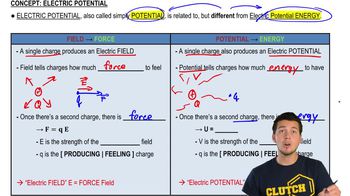
Electric Potential

Electric potential, denoted as V, is the amount of electric potential energy per unit charge at a point in an electric field. It is a scalar quantity measured in volts (V) and indicates how much work would be done to move a charge from a reference point to a specific point in the field without any acceleration.
Video consigliato:
Percorso guidato
07:33
Electric Potential

Electric Field

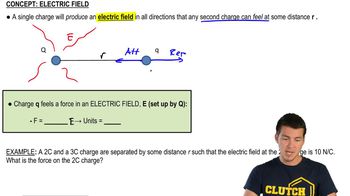
The electric field (E) is a vector field that represents the force experienced by a unit positive charge placed in the field. It is defined as the negative gradient of the electric potential, mathematically expressed as E = -dV/dx. This relationship shows how the electric field is related to the spatial change in electric potential.
Video consigliato:
Percorso guidato
03:16
Intro to Electric Fields

Gradient

In physics, the gradient is a vector that represents the rate and direction of change in a scalar field. For electric potential, the gradient indicates how the potential changes with respect to position. In this context, calculating the gradient of the potential function V = 100x^2 allows us to determine the electric field at specific points along the x-axis.