Ch 26: Potential and Field
Knight Calc - Physics for Scientists and Engineers 5th Edition
Knight Calc5th EditionPhysics for Scientists and EngineersISBN: 9780137344796Non è quello che usi tu?Cambia libro di testo
Capitolo 26, Problema 19

Light from the sun allows a solar cell to move electrons from the positive to the negative terminal, doing 2.4×10⁻¹⁹ J of work per electron. What is the emf of this solar cell?

Guida verificata passo dopo passo
1
Understand the problem: The work done per electron by the solar cell is given as 2.4×10^−19 J. The emf (electromotive force) of the solar cell is the energy provided per unit charge, which is equivalent to the work done per electron in this case. The relationship between work, charge, and emf is given by the formula: W = qV, where W is the work, q is the charge, and V is the emf.
Identify the known values: The work done per electron is 2.4×10⁻¹⁹ J, and the charge of an electron is 1.6×10⁻¹⁹ C.
Rearrange the formula to solve for emf (V): V = W/q. This equation shows that the emf is the work done per electron divided by the charge of the electron.
Substitute the known values into the formula: V = (2.4×10⁻¹⁹)/(1.6×10−19). Perform the division to find the emf.
Interpret the result: The calculated emf represents the energy provided by the solar cell per unit charge (per electron). This value is typically expressed in volts (V).

Risposta video verificata per un problema simile:

Questa soluzione video è stata consigliata dai nostri tutor come utile per risolvere questo problema.
Durata del video:
4m

Concetti chiave

Ecco i concetti essenziali che devi comprendere per rispondere correttamente alla domanda.

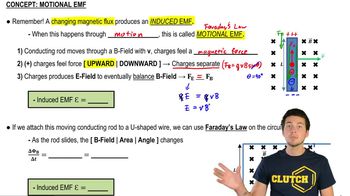
Electromotive Force (emf)

Electromotive force (emf) is the energy provided by a source of electrical energy per unit charge. It is measured in volts and represents the potential difference that drives the flow of electrons in a circuit. In the context of a solar cell, the emf indicates how much energy is available to move electrons from the positive to the negative terminal.
Video consigliato:

Work Done on Electrons

The work done on electrons refers to the energy transferred to each electron as it moves through an electric field. In this case, the solar cell does 2.4×10^−19 joules of work per electron, which is the energy gained by each electron as it is excited by sunlight. This work is directly related to the emf of the solar cell, as it quantifies the energy available for electrical work.
Video consigliato:
Percorso guidato
05:58
Work Done By Springs

Charge of an Electron

The charge of an electron is a fundamental physical constant, approximately equal to -1.6×10^−19 coulombs. This value is crucial for calculating the emf of the solar cell, as it relates the work done on each electron to the potential difference. By knowing the work done per electron and the charge, one can determine the emf using the formula: emf = work done per charge.
Video consigliato:
Percorso guidato
04:32
Electrons In Water (Using Density)