Light from the sun allows a solar cell to move electrons from the positive to the negative terminal, doing 2.4×10⁻¹⁹ J of work per electron. What is the emf of this solar cell?
Ch 26: Potential and Field
Knight Calc5th EditionPhysics for Scientists and EngineersISBN: 9780137344796Non è quello che usi tu?Cambia libro di testo
Capitolo 26, Problema 14
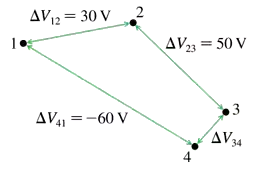
What is the potential difference ΔV34 in FIGURE EX26.14?

Guida verificata passo dopo passo1
Step 1: Identify the components in FIGURE EX26.14 that are relevant to calculating the potential difference ΔV34. Typically, this involves analyzing the circuit elements (e.g., resistors, batteries) and their arrangement between points 3 and 4.
Step 2: Apply Kirchhoff's Voltage Law (KVL), which states that the sum of the potential differences around any closed loop in a circuit is zero. Write an equation for the loop that includes points 3 and 4.
Step 3: Determine the direction of current flow and the polarity of each component (e.g., resistors cause a voltage drop, batteries contribute a voltage rise). Use Ohm's Law, \( V = IR \), for resistors if needed.
Step 4: Sum the potential differences across all components between points 3 and 4. Include contributions from batteries and resistors, ensuring you account for their polarities correctly.
Step 5: Simplify the equation to find the potential difference ΔV34. This will be the net voltage change between points 3 and 4.

Risposta video verificata per un problema simile:
Questa soluzione video è stata consigliata dai nostri tutor come utile per risolvere questo problema.
Concetti chiave
Ecco i concetti essenziali che devi comprendere per rispondere correttamente alla domanda.
Electric Potential Difference
Electric potential difference, or voltage, is the work done per unit charge in moving a charge between two points in an electric field. It is measured in volts (V) and indicates how much energy is available to move charges through a circuit. Understanding this concept is crucial for analyzing circuits and determining how energy is distributed among components.
Video consigliato:
Percorso guidato
Electric Potential
Circuit Analysis
Circuit analysis involves applying principles of electricity to understand how current flows through a circuit and how voltage is distributed across its components. Techniques such as Ohm's Law, Kirchhoff's laws, and the use of series and parallel combinations are essential for solving problems related to potential differences in circuits.
Video consigliato:
Percorso guidato
Dimensional Analysis
Reference Points in Electric Circuits
In electric circuits, reference points are essential for measuring potential differences. Typically, one point is chosen as a reference (often ground), and the potential at other points is measured relative to this reference. This concept is vital for accurately determining the voltage between two points, such as ΔV34 in the given question.
Video consigliato:
Percorso guidato
Inertial Reference Frames
Pratica correlata
Domanda del libro di testo
1247
views
Domanda del libro di testo
A −2.0 V equipotential surface and a +2.0 V equipotential surface are 1.0 mm apart. What is the electric field strength at a point halfway between the two surfaces?
1973
views
Domanda del libro di testo
FIGURE EX26.12 is a graph of V versus x. Draw the corresponding graph of Ex versus x.
80
views
Domanda del libro di testo
Determine the magnitude and direction of the electric field at points 1 and 2 in FIGURE EX26.9.
267
views
Domanda del libro di testo
The electric potential along the x-axis is V = 100x2 V, where x is in meters. What is Ex at (a) x=0 m and (b) x=1 m?
1838
views
Domanda del libro di testo
How much charge does a 9.0 V battery transfer from the negative to the positive terminal while doing 27 J of work?
204
views