Ch 26: Potential and Field
Knight Calc - Physics for Scientists and Engineers 5th Edition
Knight Calc5th EditionPhysics for Scientists and EngineersISBN: 9780137344796Non è quello che usi tu?Cambia libro di testo
Capitolo 26, Problema 17

How much charge does a 9.0 V battery transfer from the negative to the positive terminal while doing 27 J of work?

Guida verificata passo dopo passo
1
Understand the relationship between work, charge, and voltage. The formula to use here is: W = qV, where W is the work done (in joules), q is the charge (in coulombs), and V is the voltage (in volts).
Rearrange the formula to solve for charge q. This gives: q = WV.
Substitute the given values into the formula. Here, W = 27 J and V = 9.0 V.
Perform the division to calculate the charge q. This step involves dividing the work by the voltage: q = 279.0.
The result will give you the charge transferred in coulombs. Ensure the units are consistent and verify the calculation for accuracy.

Risposta video verificata per un problema simile:

Questa soluzione video è stata consigliata dai nostri tutor come utile per risolvere questo problema.

Concetti chiave

Ecco i concetti essenziali che devi comprendere per rispondere correttamente alla domanda.

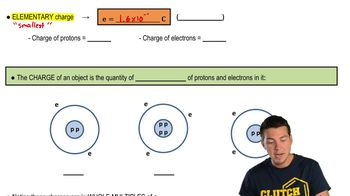
Electric Charge

Electric charge is a fundamental property of matter that causes it to experience a force when placed in an electromagnetic field. It is measured in coulombs (C) and can be positive or negative. In the context of a battery, the movement of charge from the negative terminal to the positive terminal is what generates electric current.
Video consigliato:
Percorso guidato
05:37
Electric Charge

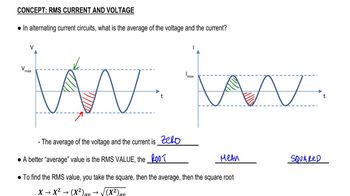
Voltage

Voltage, or electric potential difference, is the measure of the energy per unit charge available to move charges between two points in an electric field. It is measured in volts (V). In this question, the 9.0 V battery indicates the potential difference that drives the charge movement, which is essential for calculating the amount of charge transferred.
Video consigliato:
Percorso guidato
07:14
RMS Current and Voltage

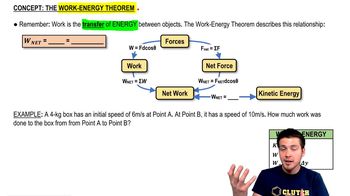
Work-Energy Principle

The work-energy principle states that the work done on an electric charge by an electric field is equal to the change in electric potential energy of the charge. In this scenario, the battery does 27 J of work, which can be related to the charge transferred using the formula W = Q × V, where W is work, Q is charge, and V is voltage.
Video consigliato:
Percorso guidato
04:10
The Work-Energy Theorem